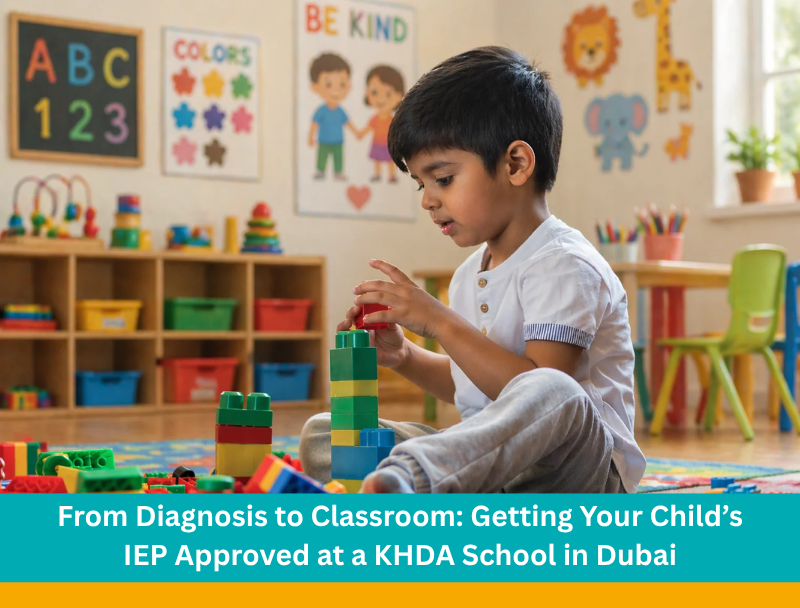
A diagnostic report is often treated as the finish line, but for most Dubai families it is closer to the starting gun. The real work — and the real difference it makes to a child’s daily life — happens in the weeks after diagnosis, when that report has to be translated into an Individual Education Plan the school actually implements in the classroom.
KHDA-registered private schools in Dubai are required under the emirate’s inclusive education framework to provide reasonable accommodations for students of determination — the term used across UAE education policy for students with disabilities or additional learning needs. But “required” does not mean automatic: families still need to actively request, document, and follow up on an IEP.
What KHDA Actually Requires of Private Schools
The Knowledge and Human Development Authority (KHDA), which regulates Dubai’s private schools, operates within the UAE’s broader inclusive education policy framework, which requires schools to identify and support students of determination rather than exclude them. In practice, this means a KHDA-registered school cannot simply decline to make reasonable accommodations once a formal diagnosis and supporting documentation are provided.
This does not mean every request is automatically approved in the form a parent hopes for — schools vary in resources, in how experienced their inclusion team is, and in how proactively they engage with the process. Knowing what the framework entitles your child to helps you advocate from an informed position rather than an uncertain one.
What an IEP Is — and What It Isn’t
An Individual Education Plan (IEP) is a documented plan specifying a child’s learning needs, the accommodations and support the school will provide, and measurable goals reviewed on a regular schedule — typically termly. It is not a diagnosis, and it is not a guarantee of a dedicated one-to-one aide, though additional support staff can be part of a plan depending on the school’s resourcing and the child’s needs.
A good IEP is specific: it should name concrete classroom strategies — seating position, extended processing time, movement breaks, visual schedules, exam accommodations — rather than vague statements like “teacher will be supportive.” Clear documentation can also help families understand the process of funding assessments and therapy tied to an IEP. Vague plans are difficult to hold anyone accountable to.
The Steps From Diagnosis to Classroom Support
- Obtain a formal diagnostic report from a DHA-licensed psychologist, psychiatrist, or relevant specialist — school-generated observations alone are not sufficient for KHDA-recognised accommodations
- Submit the report formally to the school’s inclusion or learning support team, in writing, and request a meeting to discuss an IEP — do not rely on an informal conversation with the class teacher alone
- Ask specifically which accommodations the school is proposing and why, and request these in writing as part of the IEP document
- Set a review date — typically each term — and request updated feedback from teachers ahead of that review, not just at the meeting itself
- If a request is declined or delayed, ask for the reasoning in writing; this creates a documented record and often prompts faster movement
What a Strong Diagnostic Report Includes
Schools respond faster to reports that translate clinical findings into functional classroom implications. A report that simply states a diagnosis is less useful to a school’s inclusion team than one that also specifies, for example, that a child needs extended processing time for verbal instructions, benefits from written instructions alongside spoken ones, or requires scheduled sensory breaks to remain regulated through a school day.
Our School Assessments service is built specifically to produce classroom-actionable school assessment reports Dubai, rather than a purely clinical report that a school then has to interpret on its own.
Common Reasons IEP Requests Get Delayed
The most common delays we see are requests submitted verbally rather than in writing, reports that describe a diagnosis without translating it into classroom-specific recommendations, and families who wait for the school to initiate the process rather than actively requesting a meeting. Because Dubai’s school terms move quickly, a request made in the first weeks of term — rather than after difficulties have already escalated — tends to move through the process considerably faster.
If school-specific anxiety or refusal has already started by the time you request support, it is worth reading our article on school refusal and sensory processing, which covers the earlier warning signs many parents miss.
Frequently Asked Questions
Q: What is an IEP in Dubai schools?
A: An Individual Education Plan is a documented plan outlining a student’s learning needs, the classroom accommodations and support a school will provide, and measurable goals reviewed on a regular schedule, typically each term.
Q: Do KHDA schools have to provide accommodations?
A: KHDA-registered private schools operate within the UAE’s inclusive education policy framework, which requires reasonable accommodations for students of determination once appropriate diagnostic documentation is provided.
Q: How do I get school support for my child’s diagnosis?
A: Submit a formal diagnostic report from a DHA-licensed specialist to the school’s inclusion or learning support team in writing, request a meeting to establish an IEP, and set a regular review schedule.
Q: Does a diagnosis from outside the UAE count for KHDA accommodations?
A: Reports from overseas clinicians are not always automatically accepted by KHDA-regulated schools and may require local re-evaluation by a DHA-licensed provider — it is worth confirming this with the school directly before relying solely on an overseas report.
Q: What if the school declines an accommodation request?
A: Ask for the reasoning in writing. This creates a documented record, clarifies whether the issue is resourcing or policy, and often prompts the school to revisit the request more seriously.
If you have concerns about your child’s development or would like to understand the right next step, the team at Esperanza is here to help. WhatsApp us at 00971 55 5241094 to book your free First Steps Consultation.