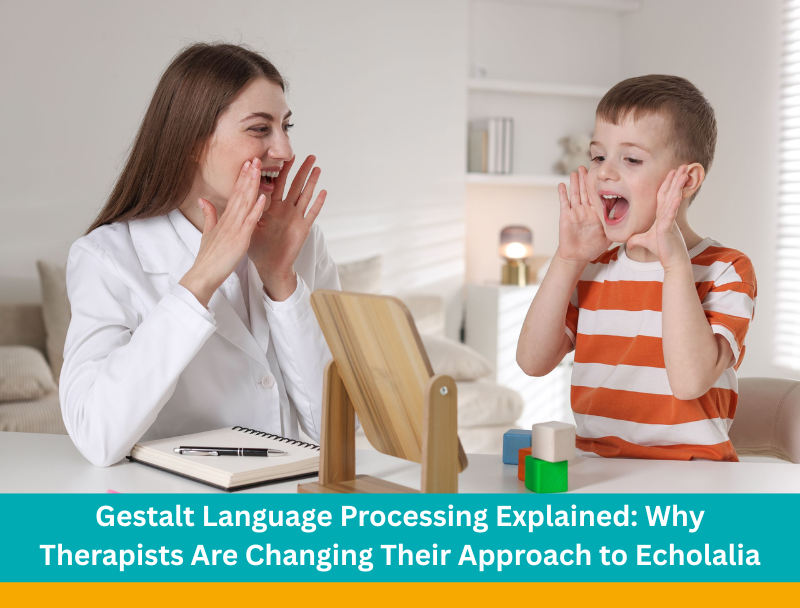
If your child repeats entire phrases from their favourite shows, recites dialogues from memory, or uses chunks of language that seem borrowed from somewhere else, you may have heard the term Gestalt Language Processing recently. In 2026, GLP has moved firmly into mainstream clinical awareness and for families in Dubai navigating speech and language concerns, understanding it properly can change everything about the support you seek.
Gestalt Language Processing (GLP) is a natural language acquisition pathway in which children learn language in whole chunks — phrases, scripts, or memorised expressions — before gradually breaking them down into flexible, self-generated speech. It is not a disorder. Children who process language this way, including many autistic children, may benefit from Gestalt Language Therapy, a supportive approach that recognises their unique way of learning and developing language rather than relying solely on the analytic word-by-word model most milestone charts assume.
If you have been told your child’s echolalia is something to correct or suppress, our Speech and Language Therapy team can offer a second perspective informed by the Natural Language Acquisition framework. It is also worth reading our article on late talking versus early neurodivergence if you are unsure how your child’s profile fits the broader picture.
What Is Gestalt Language Processing?
Language acquisition research has long recognised two broad developmental pathways. The first, analytic language processing, is the one most developmental milestone charts are built around: children learn single words first, combine them into two-word phrases, and gradually expand into longer utterances. The second is Gestalt Language Processing a pathway first described by linguist Ann Peters (1983) and later developed into a clinical framework by speech-language pathologist Marge Blanc in her 2012 text Natural Language Acquisition on the Autism Spectrum.
Gestalt language learners acquire language in whole chunks first often called scripts or gestalts. A child might say ‘do you want to build a snowman?’ not to ask a literal question, but because this phrase has become their way of inviting connection or initiating play. The communicative intent is real and meaningful. The form is borrowed. Over time, with the right therapeutic support, these chunks become the raw material from which flexible, self-generated language emerges.
Key Insight: Gestalt Language Processing is a natural, valid language acquisition route — not a disorder to be corrected. Many autistic children process language this way, as do some non-autistic children with developmental language differences.
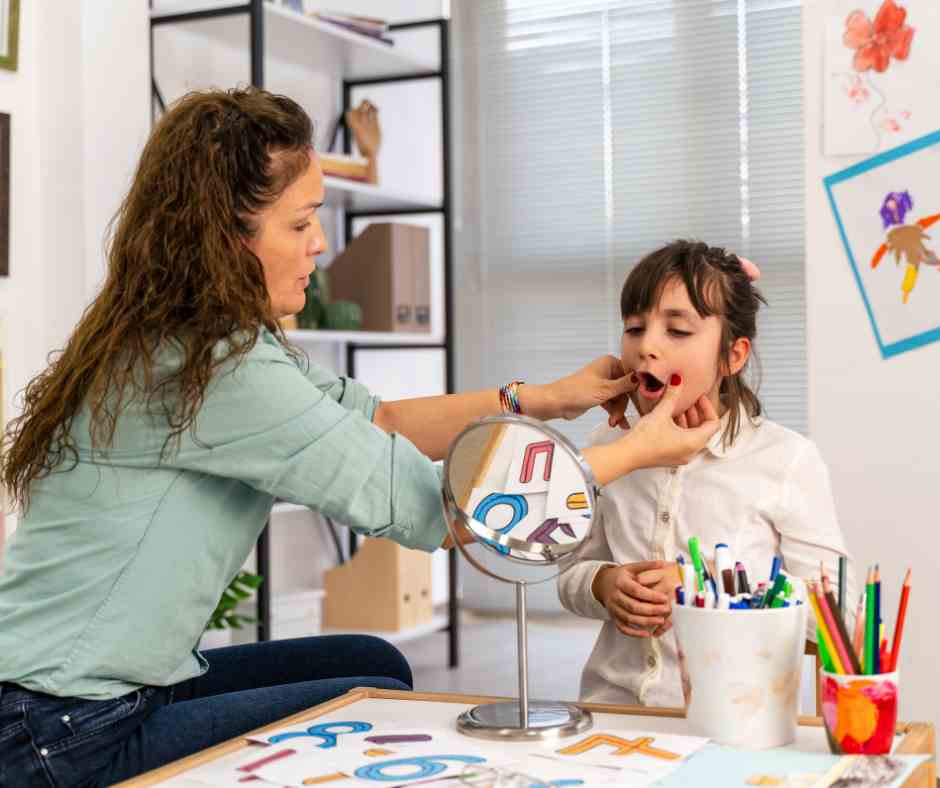
The Six Stages of Natural Language Acquisition (NLA)
Marge Blanc’s NLA framework maps GLP development across six stages. Understanding where your child sits in this progression is the foundation of GLP-informed therapy:
- Stage 1: Delayed and immediate echolalia. Children use scripts from media, caregivers, books, or their environment. These carry communicative intent even when they do not appear to on the surface.
- Stage 2: Mitigated gestalts. Children begin to modify their scripts mixing pieces, blending units. Single words may start to emerge from within familiar phrases.
- Stage 3: Isolation of single words and phrases from previous scripts. Words begin to gain independence from their original context.
- Stage 4: Beginning to combine isolated words into original two-word and three-word utterances.
- Stage 5: Combining original words into longer phrases. Language is becoming increasingly generative.
- Stage 6: Full flexible original sentences. The child has fully transitioned to spontaneous, generative language.
The most important clinical implication of this framework is that trying to suppress or eliminate echolalia in a Gestalt language learner actively disrupts their developmental pathway. Echolalia is not noise to be corrected. It is the building block of their communication system. This principle is central to how we approach Language Disorders in Children at Esperanza.
Key Insight: Suppressing echolalia in a Gestalt language learner disrupts their natural developmental trajectory. Good therapy supports and builds on it — it does not remove it.
A parent may notice their four-year-old consistently says the same phrase from a children’s film whenever they appear to want a hug, and that the phrase never varies even when the context changes. During a language assessment at Esperanza informed by the NLA framework, some children show a clear Gestalt profile with rich, communicatively meaningful echolalia before beginning to work with their therapist on ‘mapping’: the process of providing flexible language alongside familiar scripts, gradually building toward self-generated communication through child-led, play-based interaction.
Why 2026 Is a Turning Point for GLP in Clinical Practice
Until recently, many children who used Gestalt processing were assessed primarily against analytic milestones, often resulting in recommendations to eliminate scripting and push for single-word production. This approach was well-intentioned but, for GLP learners, often counterproductive suppressing the very communicative behaviours that would naturally evolve into flexible language.
In 2026, training in Marge Blanc’s NLA framework is increasingly embedded in continuing professional development for speech and language therapists globally. Parent-led advocacy, growing awareness in autism communities, and a strengthening body of clinical evidence have all contributed to this shift. Families in Bur Dubai, Karama, and Oud Metha now have access to GLP-informed practice at Esperanza. Our team is also trained in Social Skills Therapy approaches that complement GLP support for children who are developing social communication alongside their language pathway.
Key Insight: 2026 marks a pivotal moment as GLP-informed practice becomes the expected standard rather than a specialist niche — and as parents arrive at assessments already knowing the terminology.
GLP and AAC: What Parents Should Know
One of the most significant clinical intersections in 2026 is between Gestalt Language Processing and Augmentative and Alternative Communication (AAC) the use of communication tools such as symbol boards, speech generating devices, and communication apps to support or supplement verbal language.
For Gestalt language learners who remain at Stage 1 or 2 for extended periods, AAC can provide an additional modality for communication that works with, not against, the GLP pathway. AAC devices can be programmed with a child’s own scripts and phrases, respecting the Gestalt model while expanding the child’s communicative reach. Research by Branson and Demchak (2009) and more recently by Gevarter et al. (2018) supports the use of AAC alongside naturalistic intervention models for children who use echolalia.
A common parental concern is that introducing AAC will reduce a child’s motivation to develop verbal language. The evidence consistently shows the opposite: AAC tends to support, not suppress, verbal output in children with developmental communication differences.
Key Insight: AAC and GLP are not in conflict used together within a naturalistic, child-led framework, they can expand a child’s communicative reach while respecting their natural developmental pathway.
What GLP-Informed Therapy Looks Like at Esperanza
For a Gestalt language learner, a well-designed therapy session looks very different from traditional drill-based or imitation-focused approaches. Our Parent Training and Family Support programme plays a central role, because parent coaching in GLP principles is as important as direct therapy — the home environment is where most language development actually occurs. Key features of GLP-informed sessions at Esperanza include:
- Child-led sessions that follow the child’s interests and scripts, rather than directing them toward target words.
- Mapping: the therapist provides language that represents the meaning the child’s script appears to carry, gently offering flexible words alongside familiar chunks.
- Reducing communicative pressure so that echolalia is received as meaningful communication, not prompted away.
- Involving parents and caregivers as key partners in the mapping process at home.
- Progressing naturally through NLA stages without forcing stage jumps.
- Integrating AAC where it broadens communicative options without conflicting with the GLP pathway.
Key Insight: Parent coaching is as essential as direct therapy in GLP-informed support. The home environment is where most language development occurs — and where scripts first become flexible.
Frequently Asked Questions
Q: My child repeats phrases from cartoons constantly. Is this a sign of autism?
A: Echolalia, including delayed echolalia from media, is a common feature of Gestalt Language Processing and is frequently seen in autistic children, though it can occur across developmental profiles. It warrants a clinical assessment to understand the full communication picture. Visit our Autism conditions page or our article on late talking versus neurodivergence for further context.
Q: Is Gestalt Language Processing a disorder?
A: No. GLP is a natural language acquisition pathway, not a disorder or deficit. It is a different route to language development that requires a different clinical approach, but it is not inherently disordered and should not be treated as such.
Q: What is the difference between echolalia and babbling?
A: Babbling is the early vocalisation play of infants producing sounds without specific word meaning. Echolalia is the repetition of actual words or phrases heard previously, and it carries communicative intent even when that intent is not immediately obvious. Both serve developmental purposes, but echolalia in older toddlers often signals a Gestalt processing pathway that warrants clinical mapping rather than suppression.
Q: Can children move out of using echolalia?
A: Yes. GLP-informed therapy supports children in moving naturally through the NLA developmental stages from scripted language toward flexible, self-generated speech. The process varies depending on the child’s profile, starting stage, and environmental factors, but meaningful progress is consistently achievable with the right approach.
Q: Is GLP therapy available in Dubai?
A: Yes. Esperanza’s speech and language therapy team is informed by current evidence-based approaches including Natural Language Acquisition principles. You can learn more about how we work on our Speech and Language Therapy page or book a free First Steps Consultation to discuss your child’s specific profile.
Q: What should I do if I think my child is a Gestalt language learner?
A: Seek an assessment with a speech and language therapist who is familiar with Gestalt Language Processing and the NLA framework. Book a free First Steps Consultation at Esperanza and bring examples of the phrases your child uses and the contexts in which they use them. Short videos from home are particularly helpful.
If your child uses scripts, repeats phrases, or shows communication patterns that feel different from the milestones you have read about, our team at Esperanza can help you understand their communication profile with clarity and care. WhatsApp us at 00971 55 5241094 to book a free First Steps Consultation.
Esperanza Speech and Occupational Therapy Centre — Office 42B, Zomorodah Building B Block, near Central Post Office, Al Karama, Dubai, UAE. View on Google Maps