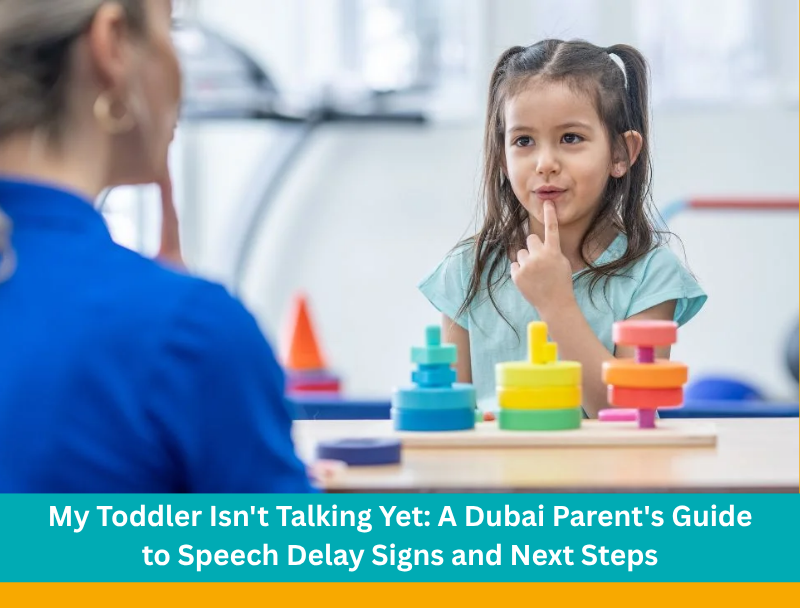
You’ve been watching your little one at the park, noticing how other children their age seem to be chattering away while yours communicates mostly through points, grunts, or the occasional sound. Maybe a well-meaning relative has commented that “he’ll talk when he’s ready,” or perhaps you’ve found yourself quietly counting the words they do say, wondering if it’s enough.
If this feels familiar, you’re in the right place. This week is about gentle awareness, not alarm. Think of it as a conversation with someone who understands the unique landscape of raising a child in Dubai, where multilingual homes are the norm, milestones can feel confusing, and it’s hard to know when to watch and when to act.
Let’s walk through this together.
A Gentle Note Before We Begin
The milestones we’re about to explore come from the CDC’s developmental guidelines. They describe expected developmental patterns, not pass or fail tests. Every child develops at their own pace, and there is a wide range of what’s considered typical.
What we’re doing here is building your awareness, giving you a framework to notice patterns, celebrate progress, and recognise when a conversation with a professional might be helpful. This isn’t about diagnosing your child; it’s about empowering you with information.
The most important thing to remember: you know your child best. If your instinct is telling you something, it deserves to be heard.
Understanding the Landscape: Speech vs. Language
Before we dive into milestones, it helps to understand two different pieces of the communication puzzle:
- Speech refers to the sounds and words themselves, pronunciation, clarity, and the ability to form sounds.
- Language refers to understanding and expressing ideas, the meaning behind the words.
A child might have a speech delay (difficulty saying sounds clearly), a language delay (difficulty understanding or expressing ideas), or both. Understanding this distinction can help you notice more precisely what you’re observing.
Your Toddler’s Communication Journey: A Checklist for Awareness
Here are the developmental patterns you might expect to see as your child grows. Remember, these are expected patterns, not strict deadlines.
Around 12 to 15 Months
What You Might Notice:
- Babbling with varied sounds (mama, dada, baba)
- Responding to their name consistently
- Using gestures, waving, pointing, raising arms to be picked up
- Understanding simple words like “no” and “bye-bye”
- Using 1 to 3 simple words meaningfully
What to Watch For:
- No babbling or pointing by 12 months
- Doesn’t respond to their own name
- Doesn’t use any gestures to communicate
Around 18 Months
What You Might Notice:
- Using at least 10 to 20 words
- Pointing to objects or pictures when named
- Following simple one-step instructions (“give me the ball”)
- Imitating everyday sounds
What to Watch For:
- No spoken words
- Difficulty imitating sounds or words
- Limited gestures or reliance only on pointing
- Doesn’t understand simple commands
Around 2 Years
What You Might Notice:
- Using at least 50 words
- Beginning to combine two words (“more milk”, “daddy go”, “no sleep”)
- Strangers understanding about half of what they say
- Pointing to body parts when named
What to Watch For:
- Fewer than 20 to 50 words
- No two-word combinations by 24 months
- Significant difficulty being understood even by family
- Persistent frustration when trying to communicate
Around 2.5 to 3 Years
What You Might Notice:
- Using short sentences of 3 to 4 words
- Asking and answering simple questions
- Strangers understanding most of what they say
- Playing with other children and turning book pages
What to Watch For:
- Unclear speech that’s still difficult for family to understand
- Persistent difficulty combining words into phrases
- Not asking questions or engaging in back and forth conversation
The Multilingual Factor: What’s Different in Dubai
Dubai is one of the most multilingual cities in the world, and that’s a gift for our children. But it also creates unique questions about speech development.
Here’s the reassuring truth: growing up with more than one language does not cause speech or language delays. Bilingual and multilingual children typically reach the same major milestones as their monolingual peers, they just distribute their vocabulary across languages.
For example, a two-year-old who knows 25 words in English and 25 words in Arabic has the same total expressive vocabulary as a peer who knows 50 words in a single language.
What’s normal in multilingual development:
- Mixing languages in the same sentence (code-switching)
- Using one language more strongly than another
- A brief “silent period” when exposed to a new language
- Appearing stronger in one language while the other is still developing
What a speech-language pathologist looks for: true delays show up in both languages, not just one. If your child’s communication is progressing across their combined languages, they’re likely on track.
When to Seek Help: Trusting Your Instincts
Knowing when to seek professional support can feel like a big decision. Here is a short guide to whether your child needs support, along with some signs that it might be time to have a conversation:
- Loss of skills: your child had words and then stopped using them. This regression warrants a prompt evaluation.
- No meaningful words in any language by 16 to 18 months
- No two-word phrases in any language by 24 months
- Significant difficulty being understood by family members in their dominant language by age 3
- Persistent frustration when trying to communicate
- Your parent instinct: if you feel something is off, that matters. Parents know their children better than anyone.
Why early matters: the first three years of life are the most intensive period for acquiring speech and language skills. This is also the window in which early intervention tends to have the greatest impact, giving your child the best possible chance of catching up fully. Early assessment costs nothing except time; delayed assessment can cost critical months of development.
Your Gentle Next Steps: A Mid-Article Check-in
Take a moment to reflect on what you’ve read. Have you noticed any patterns? Are there milestones your child is meeting with ease, and others where they need more time?
It’s helpful to jot down what you’re observing. Notice the words your child uses, the sounds they make, and how they communicate without words (pointing, gestures, eye contact). Think about how they’re progressing in both their languages at home, not just one.
The CDC recommends that children be screened for general development at 9, 18, and 30 months, and for autism at 18 and 24 months. If you have concerns, you don’t have to wait for a scheduled screening, you can talk with your paediatrician at any time.
Making Sense of Speech Therapy in Dubai
If you decide to seek support, here’s what to expect from speech and language therapy in Dubai:
The assessment process:
- A comprehensive evaluation of skills in both or all languages your child is exposed to
- A detailed language history from parents, covering which languages the child hears, in what contexts, and from whom
- Play-based, child-centred assessment that feels like fun, not pressure
What therapy looks like:
- Therapy for toddlers looks like play, but it’s carefully planned
- Sessions often include sound imitation games, vocabulary building through toys, songs, and routines, and parent coaching so you can support language throughout the day
- Many Dubai clinics offer parent-inclusive approaches, making you an active participant rather than just an observer
The bilingual advantage: Dubai has experienced therapists who understand the multilingual context. A good First Steps consultation will distinguish between a true language disorder and a language difference, a child who’s still acquiring a new language.
This Week’s Gentle Practice
If you’re in the discovery stage, here’s something simple to try:
- Observe without pressure. This week, just notice. Pay attention to your child’s communication in different contexts, at home, at nursery, during play. Notice both what they’re doing and what they’re not yet doing. Write it down if it helps.
- Limit passive screen time. Research suggests that passive screen exposure can delay language development. Instead, replace some screen time with interactive storytelling, music, or simple conversation.
- Talk, narrate, and wait. Describe what you’re doing in brief sentences. Ask open questions and then wait 5 to 10 seconds for your child to respond before jumping in. This creates space for them to engage, even if their response is a gesture or a sound.
- Model, don’t correct. If your child says “wa-wa” for water, simply model the correct word: “Yes, water. Here’s your water.” This reinforces without pressure.
Ready for More Support?
If you’ve been reading this and nodding, or if you’re simply curious about what you’re observing, you’re doing exactly the right thing. You’re paying attention.
When you’re ready for the next step, we’re here to help. We offer a comprehensive Speech Delay Checklist (0 to 3 Years) that can help you track what you’re noticing and prepare for a conversation with a professional.
You know your child best. Trust that. And remember, asking questions isn’t worry, it’s love in action.
If you have concerns about your child’s communication, sensory development, feeding, emotional regulation, or developmental milestones, the team at Esperanza is here to help you navigate the next steps with compassion and clinical care.
WhatsApp us at 00971 55 5241094 to book a First Steps consultation.
Frequently Asked Questions
Frequently Asked Questions About Toddler Speech Delay in Dubai
How many words should a 2-year-old say?
A 2-year-old typically begins using around 50 words and combining two words, although children develop at different rates. For children growing up with two or more languages, consider their combined vocabulary across all languages, rather than counting words in English alone. If you are concerned about your child’s communication, a speech and language assessment can help clarify whether their development is progressing as expected.
Is my 2-year-old’s speech delayed?
A 2-year-old may benefit from a professional assessment if they are using very few meaningful words, are not combining two words, have difficulty understanding simple language, are difficult to understand, or become frustrated when trying to communicate. A child’s overall communication—including gestures, understanding, interaction and words—should be considered rather than looking at word count alone.
Does bilingualism or speaking two languages cause speech delay?
No. Bilingualism does not cause speech or language delay. Children growing up with two or more languages may distribute their vocabulary across those languages and may mix languages while communicating. For a multilingual child, a speech-language professional should consider communication across all languages the child regularly hears and uses.
When should I take my toddler to a speech therapist in Dubai?
Consider speaking with a speech therapist if your toddler has persistent difficulty using or understanding language, is not meeting expected communication milestones, becomes frustrated when trying to communicate, or has lost words or communication skills they previously had. You do not need to wait for a concern to become severe before asking for professional guidance.
What are the signs of speech delay in a toddler?
Possible signs include limited meaningful words, difficulty combining words, difficulty understanding simple instructions, limited imitation of sounds or words, reduced use of gestures, difficulty being understood, or frustration because the child cannot communicate what they want. Loss of previously acquired words or communication skills should be discussed with a healthcare or developmental professional promptly.
What is the difference between speech delay and language delay?
Speech relates to how a child produces sounds and words, including clarity and pronunciation. Language relates to understanding and expressing meaning. A toddler can have a speech difficulty, a language delay, or both. A speech-language assessment helps determine which areas need support.
Where can I find a toddler speech therapist in Karama, Dubai?
Esperanza Speech & Occupational Therapy Centre is located in Al Karama, Dubai, and provides speech and language assessment and therapy for children. The centre is conveniently located for families in Karama, Bur Dubai, Oud Metha, Mankhool, Al Jafiliya and Al Kifaf, as well as families travelling from other parts of Dubai.
Is there speech therapy for toddlers near Bur Dubai and Oud Metha?
Yes. Families living in Bur Dubai, Oud Metha, Mankhool, Karama, Al Jafiliya and Al Kifaf can access paediatric speech and language support at Esperanza in Al Karama. The location also serves families from areas including Downtown Dubai, Business Bay, Jumeirah, Sheikh Zayed Road and Trade Centre.
What happens during a toddler speech and language assessment in Dubai?
A paediatric speech and language assessment typically looks at how a child understands language, communicates wants and needs, uses words and gestures, interacts with others, imitates sounds and words, and communicates across the languages they are exposed to. At Esperanza, assessment is child-centred and play-based, with parents providing important information about the child’s development and communication at home.
Can speech therapy help a toddler who isn’t talking yet?
Speech and language therapy can help identify why a toddler may be having difficulty communicating and provide strategies to build communication skills. Depending on the child’s needs, therapy may focus on understanding language, using words and gestures, imitation, vocabulary, combining words, social communication and helping parents support communication during everyday routines and play.
Should I wait and see if my toddler starts talking?
Sometimes children who talk later continue to develop without significant difficulty, but persistent concerns should not automatically be dismissed as something a child will simply grow out of. If your toddler has limited progress, significant communication difficulties, or has lost previously acquired skills, discussing your concerns with a qualified professional can provide clarity and help you decide what to do next.
Is screen time linked to speech delay?
Passive screen use can reduce opportunities for the back-and-forth interaction that supports early communication. Rather than focusing only on removing screens, parents can create more opportunities for talking, reading, singing, playing, responding to gestures and taking turns throughout the day.
How can I help my toddler talk more at home?
Talk about what your child is doing, follow their interests, read together, sing songs, imitate their sounds, offer choices and give them time to respond. If your child says “wa-wa,” for example, you can respond naturally with “Yes, water!” rather than repeatedly asking them to say the word correctly. Everyday interactions can provide valuable opportunities for communication.
Does my child need to speak English for a speech assessment in Dubai?
No. A child does not need to speak English for their communication development to be assessed. For bilingual and multilingual children, it is important to understand the languages they hear and use at home, nursery and in the community. Parents should provide information about the child’s communication across their languages so the assessment reflects the child’s overall communication abilities.
How do I start speech therapy for my toddler in Dubai?
A good first step is to discuss your concerns with a qualified speech-language professional. At Esperanza Speech & Occupational Therapy Centre in Al Karama, Dubai, families can begin with a First Steps consultation, where a licensed therapist listens to your concerns, observes your child’s communication and helps you understand appropriate next steps.
How can I book a toddler speech consultation at Esperanza in Karama?
You can contact Esperanza Speech & Occupational Therapy Centre in Al Karama, Dubai, to discuss your child’s communication and arrange a First Steps consultation, where a licensed therapist listens, observes, and talks through what you’re noticing at home.
The consultation is designed to give parents a clearer understanding of their child’s communication and whether further assessment or support may be appropriate.