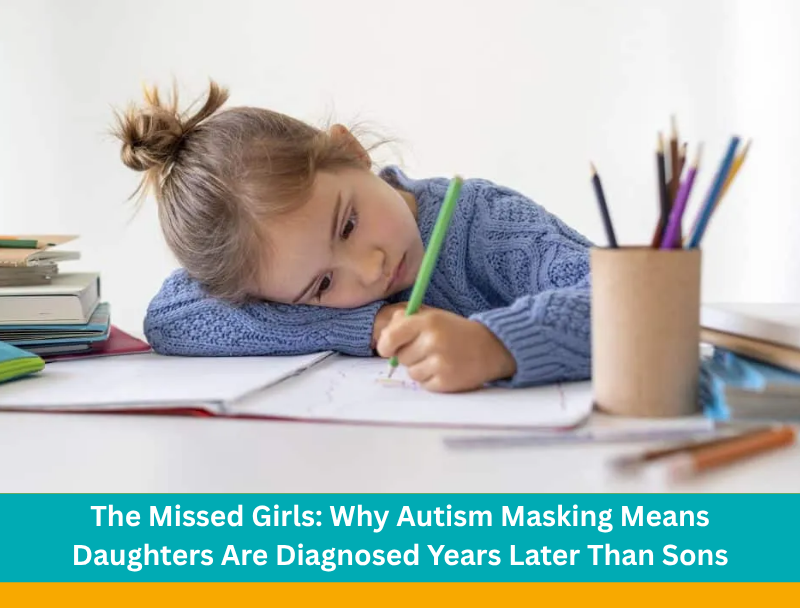
For every parent who tells us “my son was diagnosed at three, but nobody flagged anything for my daughter until she was nine, and by then she was refusing school and having daily meltdowns at home” — there is a clinical explanation, and it is not that the daughter’s autism was milder. In many cases, it was simply harder to see, because she had spent years learning to hide it.
Autism has long been described using a roughly four-to-one male-to-female ratio, but larger reviews suggest the true ratio is closer to three-to-one — the gap between those numbers represents girls who were not identified. A significant reason is camouflaging: the conscious and unconscious strategies many autistic girls use to appear neurotypical in public, often at real emotional cost.
What Autism Masking (Camouflaging) Actually Means
Masking, sometimes called camouflaging, describes the strategies an autistic person uses to hide or suppress their natural traits and imitate neurotypical behaviour in social settings. This can include forcing eye contact that feels physically uncomfortable, rehearsing conversations in advance, closely studying and copying a popular peer’s mannerisms, and suppressing repetitive movements or stimming until they are alone.
Camouflaging research from clinicians and researchers including those at the University of Cambridge’s Autism Research Centre has described this pattern consistently among autistic girls and women, who tend to report camouflaging more, and starting it earlier, than autistic boys and men.
Why the Old “Four Boys to One Girl” Ratio Is Misleading
For decades, autism prevalence figures cited a ratio of roughly four boys diagnosed for every one girl. A 2017 meta-analysis published in the Journal of the American Academy of Child & Adolescent Psychiatry re-examined this figure across a large number of studies and found that when researchers controlled for referral bias — the fact that boys are simply referred for assessment more often — the true ratio appeared closer to three to one.
That gap matters. It suggests a meaningful number of autistic girls are not being identified through the usual referral pathways at all, often because their presentation does not match what teachers, paediatricians, and even some clinicians have been trained to recognise as autism.
What Masking Looks Like Day to Day
- A daughter who is described as “well-behaved,” “quiet,” or “a bit shy” at school, but who has intense meltdowns the moment she gets home — sometimes called “after-school restraint collapse”
- Friendships that look social on the surface but involve closely scripting what to say, or attaching to one intense friendship rather than a wider peer group
- Special interests that look more socially typical than a boy’s might — animals, particular book series, celebrities — and are therefore not read as a red flag by adults
- Physical symptoms of chronic stress: stomach aches, headaches, or reluctance to go to school without an obvious social conflict
- A pattern of being described as “anxious” or “sensitive” for years before autism is ever raised as a possibility
Why Schools and Even Clinicians Can Miss It
Standard autism screening tools were largely developed and validated using predominantly male samples, which means some of the classic markers they look for — narrow, unusual special interests, overt social withdrawal — are less likely to appear in the way girls present. A girl who wants friendships and actively works to build them, even if that work is exhausting and unsustainable, can be screened out of a diagnosis that focuses on social withdrawal alone.
This is closely connected to why AuDHD can also go unrecognised in girls for years, since attention and regulation difficulties are similarly filtered through gendered expectations of behaviour — a pattern we explore further in our article on AuDHD in children.
When to Seek an Assessment for a Daughter
A late or missed diagnosis is not a small administrative gap — it means years without the right support, and often years of a child believing something is simply wrong with her rather than understanding that her brain works differently. If your daughter holds it together at school but falls apart at home, has one or two extremely close friendships rather than a wider social circle, or has always seemed to be “trying very hard” socially in a way that leaves her exhausted, a formal developmental assessment is worth pursuing regardless of her age.
Our Common Concerns and How We Support You page addresses many of the everyday patterns families notice before they have the language for what they are seeing.
Frequently Asked Questions
Q: Why is autism harder to spot in girls?
A: Many autistic girls learn to camouflage their traits — copying peers, scripting conversations, and suppressing repetitive behaviours in public — which means their presentation often does not match the traits standard screening tools were designed to detect.
Q: What is autism masking or camouflaging?
A: Masking describes the conscious and unconscious strategies an autistic person uses to hide their natural traits and appear neurotypical, such as forced eye contact, rehearsed social scripts, and suppressed stimming.
Q: At what age are girls usually diagnosed with autism?
A: Research consistently shows girls are diagnosed later than boys on average, often not until difficulties with anxiety, school refusal, or social exhaustion become significant enough to prompt a referral in later childhood or adolescence.
Q: Does masking mean the autism is ‘mild’?
A: No. Masking is a coping strategy, not a measure of severity, and it often comes at a significant emotional cost — including exhaustion, anxiety, and meltdowns once the effort of masking is no longer required, typically at home.
Q: Can AuDHD also be missed in girls?
A: Yes, and for similar reasons. Attention and regulation difficulties in girls are often interpreted as daydreaming, anxiety, or disorganisation rather than assessed for ADHD or AuDHD.
If you have concerns about your child’s development or would like to understand the right next step, the team at Esperanza is here to help. WhatsApp us at 00971 55 5241094 to book your free First Steps Consultation.