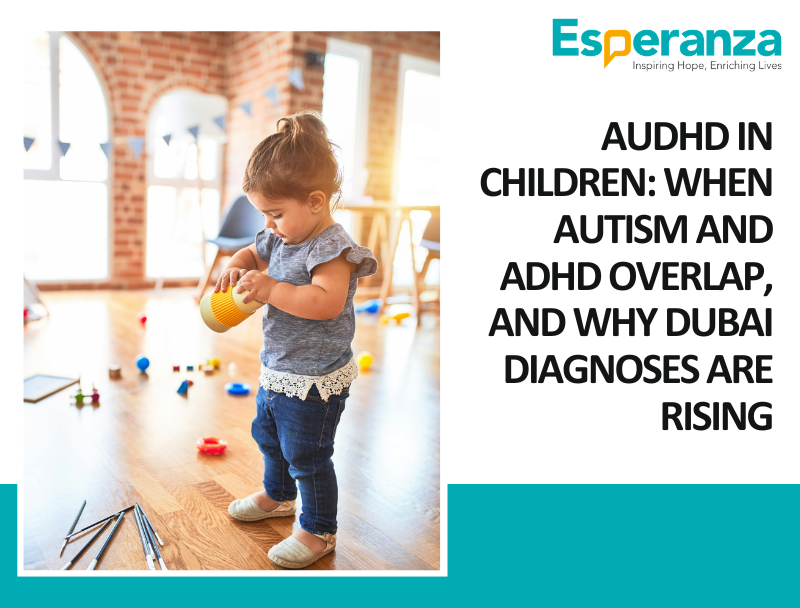
Parents increasingly arrive at our clinic having already done their own research, and one term comes up more often every year: AuDHD. It is not a formal diagnostic label in the DSM-5, but it has become the everyday shorthand families and clinicians use for a child who meets criteria for both autism spectrum disorder and attention-deficit/hyperactivity disorder at the same time. If you have wondered whether your child could be “both,” you are asking a question that clinical practice has only fully caught up with in the last decade.
Until 2013, clinicians were not permitted to diagnose autism and ADHD in the same child — the diagnostic manual treated them as mutually exclusive. That rule no longer applies. Research now suggests attention and regulation difficulties meeting clinical thresholds are common in autistic children, and the reverse is also true. AuDHD is not rare; it is simply newly nameable.
What Changed in 2013, and Why It Matters Now
Before the fifth edition of the Diagnostic and Statistical Manual of Mental Disorders (DSM-5) was published in 2013, a child could not formally receive both an autism and an ADHD diagnosis — clinicians were required to pick one. That exclusion rule was removed because it did not reflect what clinicians were actually observing in practice: a substantial number of autistic children also showed clear, impairing patterns of inattention, impulsivity, or hyperactivity that warranted their own diagnosis and their own therapy targets.
Since then, research attention to combined presentations has grown steadily. Reviews in the child psychiatry literature consistently describe attention and regulation difficulties as one of the most common co-occurring profiles in autistic children — common enough that many specialists now consider it unusual for a comprehensive autism assessment not to also screen for ADHD traits, and vice versa.
Why AuDHD Often Looks Different From “Textbook” Autism or ADHD
A child with autism alone is often described in terms of routine, predictability, and a narrow set of intense interests. A child with ADHD alone is often described as impulsive, easily bored, and quick to move between activities. When both are present, these traits do not simply add together — they interact, and often mask each other.
A child may pursue a special interest with autistic intensity but pursue it impulsively and disorganised, jumping between related topics rather than the deep, methodical focus seen in autism alone. A child may want social connection in a way that looks more ADHD than autistic — approaching peers eagerly — but then struggle with the back-and-forth reciprocity of the interaction in a way that looks more autistic than ADHD. This blended picture is precisely why AuDHD is easy for a single-lens assessment to miss.

Signs Dubai Parents Often Notice First
- Meltdowns that seem to combine sensory overload with impulsive frustration — not purely a sensory shutdown, and not purely a tantrum
- Strong, specific interests pursued in bursts rather than sustained, methodical focus
- Difficulty with peer friendships that seems to stem from both missing social cues and acting before thinking
- Inconsistent attention — intensely focused on preferred activities, but unable to sustain attention on anything else
- A pattern of being labelled “the naughty one” and “the sensitive one” by different adults in the same week
Why AuDHD Is Often Missed or Delayed
Clinical training has historically treated autism and ADHD as separate specialisms, assessed with separate tools by separate teams. A child screened only for hyperactivity may not be flagged for autism if their attention difficulties are the most visible feature. A child screened only for social communication may not be flagged for ADHD if their behaviour in a quiet, one-to-one clinical room looks calmer than it does in a noisy classroom of 25 children. This is why integrated approaches, including ADHD support Dubai, are essential to ensure children receive accurate diagnoses and the right support across different environments.
This blind spot affects boys and girls differently, and it is a significant part of why so many girls in particular are diagnosed late or not at all — a pattern we cover in detail in our article on autism masking in girls.
Building a Therapy Plan That Treats the Whole Picture, Not Two Separate Children
The most common mistake we see is a therapy plan built around only one diagnosis, leaving the other condition’s impact on daily function unaddressed. An integrated plan at Esperanza typically draws on speech and language therapy, occupational therapy, and behaviour therapy for children working from one shared understanding of the child — not three separate interpretations of the same set of behaviours.
Our occupational therapy team places particular emphasis on the sensory regulation and executive function components of ADHD, which we cover in more depth in our article on ADHD and occupational therapy. When these pieces are addressed together, families typically see faster, more consistent progress than when each condition is treated in isolation.
Frequently Asked Questions
Q: Can a child have both autism and ADHD?
A: Yes. Since the DSM-5 removed the exclusion rule in 2013, autism and ADHD can be formally diagnosed together in the same child. Combined presentations are now recognised as common rather than exceptional.
Q: What is AuDHD?
A: AuDHD is not an official diagnostic term — it is the everyday name families and clinicians use for a child who meets criteria for both autism spectrum disorder and ADHD. On paper, it appears as two separate diagnoses on an assessment report.
Q: Why is AuDHD often misdiagnosed or missed?
A: Because autism and ADHD have traditionally been assessed by different specialists using different tools, a child’s more visible traits — whether social-communication differences or attention and impulsivity — can overshadow the other condition during a single-lens assessment.
Q: Does my child need separate therapy for autism and ADHD?
A: Not necessarily two separate programmes. An integrated plan that addresses sensory regulation, executive function, and social communication together, delivered by a coordinated therapy team, is generally more effective than treating each diagnosis in isolation.
Q: At what age can AuDHD be identified?
A: Traits of both conditions can often be observed from the toddler and preschool years, though a formal combined diagnosis usually requires a comprehensive developmental assessment that looks at both attention/regulation and social communication together.
If you have concerns about your child’s development or would like to understand the right next step, the team at Esperanza is here to help. WhatsApp us at 00971 55 5241094 to book your free First Steps Consultation.
Esperanza Speech and Occupational Therapy Centre — Office 42B, Zomorodah Building B Block, near Central Post Office, Al Karama, Dubai, UAE.