The message may have come from a nurse before you even left the maternity ward. Or perhaps a follow-up letter arrived a few days later. Either way, the words carry weight: your baby did not pass the hearing screening.
In the hours after receiving that result, it is completely natural to feel frightened. Your mind may have jumped immediately to the worst-case scenario. But before you go there, there is something important you need to know.
A failed newborn hearing screening does not mean your baby cannot hear. It does not mean your baby has a hearing loss. It means your baby needs a follow-up test. That is all.
This guide is written for the moment you are in right now. It explains what the screening test actually measures, why so many newborns receive a refer result for entirely harmless reasons, what happens next within Dubai’s healthcare system, and what you can gently watch for at home as you wait for follow-up testing. If you would like to speak with someone before your next appointment, our First Steps consultation is always available as a gentle starting point.
1. What Is a Newborn Hearing Screening and Why Does Every Baby Have One?
A newborn hearing screening is a routine, painless check carried out on babies in their first days of life. In Dubai, newborn hearing screening has been standard practice at most hospitals since 2014, and it is increasingly mandated across the UAE to ensure that all babies are screened before hospital discharge.
The reason every baby is screened is straightforward. Hearing loss is one of the most common conditions present at birth, affecting around 1 to 3 babies in every 1,000 live births globally. And yet it is also one of the most easily missed without a dedicated screening programme. A baby with hearing loss often appears entirely typical in their behaviour in the early weeks of life. They sleep. They feed. They respond to touch and movement. Without a hearing screen, a significant number of children reach the age of two or three before their hearing loss is identified, by which point the most critical window for language development has already passed.
The screening exists to catch hearing differences early, so that if support is needed, it can begin as soon as possible.
| Key Insight: Newborn hearing screening is a routine test carried out in the first days of life to identify potential hearing differences early, allowing support to begin during the most critical period for language development. |
2. What the OAE Test Actually Is and What It Measures
The most commonly used newborn hearing screening test is the OAE test. OAE stands for Otoacoustic Emissions. The name sounds clinical, but the test itself is simple and takes only a few minutes.
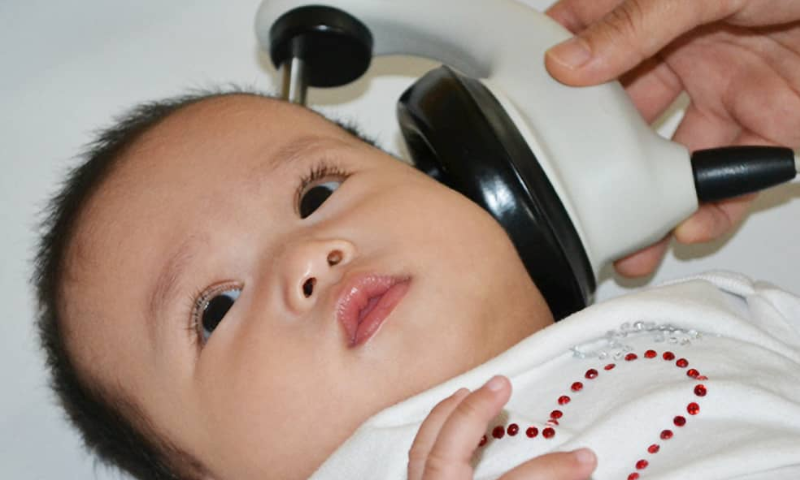
A small, soft-tipped probe is placed gently in the outer part of your baby’s ear. The probe plays a series of very quiet sounds down the ear canal. When a healthy inner ear receives sound, it naturally produces a faint echo in return. This echo is called an otoacoustic emission. The probe detects whether that echo is present.
If the echo is detected: the result is a pass. The inner ear appears to be functioning as expected.
If no echo is detected: the result is a refer, sometimes called a fail. This means the test could not confirm normal inner ear function on this occasion.
Crucially, the OAE test does not tell us why the echo was not detected. There are many reasons why a healthy ear may not produce a detectable echo during a newborn screen, and most of them have nothing to do with permanent hearing loss.
| Key Insight: The OAE test plays quiet sounds into the ear and listens for the inner ear’s natural echo. A refer result means the echo was not detected on this occasion, not that hearing loss has been confirmed. |
3. What the ABR Test Is and When It Is Used
If a baby does not pass the OAE screen, a second type of test is often used. This is called the ABR test, or Auditory Brainstem Response test. You may also see it referred to as AABR (Automated Auditory Brainstem Response) or BERA (Brainstem Evoked Response Audiometry).
The ABR test works differently from the OAE. Rather than listening for the inner ear’s echo, it measures how the hearing nerve and brain respond to sound. Three small sensor stickers are placed on your baby’s head and neck, and soft headphones designed for newborns are placed over the ears. A series of clicking sounds is played, and the equipment measures the brain’s electrical response.
This test can take between five and thirty minutes. It works best when your baby is calm or asleep, which is why feeds and sleep timing are sometimes coordinated around the appointment.
The ABR test is more detailed than the OAE screen and can give clearer information about whether the hearing nerve is responding normally to sound.
| Key Insight: The ABR test measures how the hearing nerve and brain respond to sound. It is more detailed than the OAE screen and is used when a follow-up assessment is recommended after a refer result. |
Parent Scenario
A parent may notice that their newborn sleeps through the OAE test entirely, waking only as the probe is removed. During the follow-up ABR appointment three weeks later, the same baby responds clearly to the clicking sounds used in the test, with the audiologist confirming normal hearing nerve responses. Some families find this second appointment brings the relief they needed. Others receive more nuanced results that lead to further conversations about next steps.
4. Why a Failed Result Does Not Mean Hearing Loss
This is the most important section of this article, and the one that is most likely to bring you some calm.
Between 1 and 2 per cent of all newborns receive a refer result on the initial OAE screen. Of those babies, the majority are found to have completely normal hearing when follow-up testing is completed.
There are several common reasons why a healthy ear may not produce a detectable OAE result:
- Fluid in the ear canal. Amniotic fluid or vernix from the birth process can block the ear canal in the first days of life, preventing a clear echo from being recorded.
- Fluid in the middle ear. Even without an ear infection, many newborns have temporary fluid behind the eardrum that can interfere with the test result.
- Background noise. The OAE test is sensitive to the acoustic environment. A busy postnatal ward, a crying baby in the next cot, or even the sound of the baby’s own breathing can affect the result.
- A restless or crying baby. Movement and sound from the baby themselves can prevent the probe from picking up the echo accurately.
- Probe placement. Newborn ear canals are very small. Achieving a perfect seal for the OAE probe is not always possible on the first attempt.
None of these reasons indicate hearing loss. They are all practical, temporary, and entirely unrelated to the long-term function of your child’s hearing system.
| Key Insight: Most babies who fail the initial newborn hearing screen are found to have normal hearing on follow-up testing. A refer result most often reflects the conditions of the test, not the function of your baby’s ears. |
5. The 1-3-6 Rule: The Timeline Every Dubai Parent Needs to Know
If your baby has received a refer result, you will hear about follow-up testing. Understanding the recommended timeline helps you stay on track without feeling overwhelmed.
The global standard used by audiologists and early intervention specialists is known as the 1-3-6 rule:
| Screen by 1 Month | Diagnose by 3 Months | Begin Support by 6 Months |
| All newborns should have a hearing screen before hospital discharge or within the first four weeks of life. | If the first screen gives a refer result, diagnostic testing should be completed by three months of age. | If hearing loss is confirmed, early intervention and therapy support should begin by six months of age. |
Following this timeline matters because the first six months of life are the most sensitive period for auditory brain development. A baby’s brain is building the neural pathways that will underpin all future listening, language, and communication development. The earlier any support begins, the more of that critical window is available to work with.
If you are in Dubai and your baby has received a refer result, our early intervention team can help you understand the pathway ahead, including what to expect from follow-up audiology appointments and when a speech therapist becomes part of the picture.
| Key Insight: The 1-3-6 rule: screen by 1 month, diagnose by 3 months, begin intervention by 6 months if hearing loss is confirmed. This timeline protects the most critical window for language development. |
6. What Happens Next in Dubai’s System After a Refer Result
If your baby received a refer result at the hospital, you will typically be given a referral to an ENT clinic or a dedicated audiology service. In Dubai, follow-up testing is available through both DHA-affiliated public hospitals and a number of private clinics.
The follow-up appointment will usually involve one of the tests described above: another OAE screen, an ABR, or a combination of both. The audiologist will explain the results to you clearly and advise on next steps.
There are three possible outcomes at the follow-up stage:
- The baby passes follow-up testing. Hearing is confirmed as normal. No further action is required, though routine monitoring at developmental check-ups continues.
- The results are unclear or borderline. Further testing may be recommended, or a watch-and-wait approach with close monitoring over the following months.
- Hearing loss is confirmed. The audiologist will discuss the degree and type of hearing loss, and a referral pathway including hearing technology and early intervention will be initiated.
Whatever the outcome, you do not have to navigate this alone. Families travelling from Karama, Oud Metha, Trade Centre, Downtown Dubai, Jumeirah, and Hudaiba regularly access both audiology and speech therapy support through Esperanza’s central location. Our team is familiar with Dubai’s referral pathways and can help you understand each step.
| Key Insight: Follow-up testing after a refer result leads to one of three outcomes: confirmed normal hearing, unclear results requiring further monitoring, or a confirmed hearing loss with a clear next steps pathway. |
7. Signs You Can Gently Observe at Home
While you wait for follow-up appointments, you do not need to sit and worry. There are gentle, natural ways to observe your baby’s responses to sound that can give you useful information and also help you feel less passive in the process.
Use this table as a soft guide only. It is not a diagnostic tool. Babies vary enormously in how they express their responses, and absence of a response in any one context does not mean hearing loss is present.
| Age | What to Notice |
| 0 to 3 months | Startles or stirs at sudden loud sounds. Quietens to a familiar voice. Responds to voices more than to other sounds. |
| 3 to 6 months | Turns eyes or head towards a sound source. Responds to different tones of voice. Begins to babble and make vowel sounds. |
| 6 to 9 months | Turns head clearly towards sounds and voices. Recognises familiar words such as their own name. Babbling increases in variety. |
| 9 to 12 months | Responds to simple requests such as No or Come here. Begins to imitate sounds. Points or looks when named objects are mentioned. |
| 12 to 18 months | Follows simple one-step instructions. Uses a small number of words with intent. Responds when called from another room. |
If you notice that your baby consistently does not respond to sounds in their environment over several weeks of observation, this is worth discussing with your GP, paediatrician, or an audiologist. Trust your instincts. You know your baby.
8. When to Contact a Speech Therapist
Many parents assume that speech therapy only becomes relevant once a child is old enough to start talking. This is one of the most common misconceptions about early hearing and communication support, and it means some families miss the most valuable period to begin.
A speech and language therapist can be involved from the very earliest stages of a child’s life when hearing concerns are present. Our speech and language therapy team at Esperanza works with families from diagnosis onwards, well before a child has produced a single word.
Reasons to contact a speech therapist early include:
- Your baby’s hearing loss has been confirmed and you have questions about what communication development looks like from here.
- Your baby has passed the hearing screen but you have ongoing concerns about how they respond to voices and sounds.
- Your baby’s follow-up appointment has been booked but you would like guidance on what to do at home in the meantime.
- You want to understand whether Auditory-Verbal Therapy might be appropriate for your child and your family.
You do not need a formal hearing loss diagnosis to reach out. Early conversations with a therapist are always informational and supportive. There is no commitment, no pressure, and nothing to lose from having the conversation early.
| Key Insight: Speech and language therapy support can begin from the point of a hearing concern, long before a child begins speaking. Early involvement gives families the best possible foundation. |
9. If Hearing Loss Is Confirmed: What Support Looks Like
If follow-up testing confirms that your child has a hearing loss, the path forward becomes clearer than it may feel right now. Hearing loss in infants is one of the most well-understood conditions in paediatric therapy, and the support available in Dubai has developed significantly in recent years.
The typical journey after a confirmed diagnosis includes:
- Audiological management. The audiologist will determine the type and degree of hearing loss and discuss hearing technology options, which may include hearing aids, bone-conduction devices, or cochlear implants depending on the degree of loss.
- Hearing technology fitting. Hearing aids can be fitted for babies as young as a few weeks old. Where cochlear implants are being considered, the assessment process begins early to ensure candidacy is established in good time.
- Early intervention and therapy. A speech and language therapist, often one with specialist training in Auditory-Verbal Therapy, will begin working with the family as soon as technology is in place.
- Family coaching. Parents and caregivers are central to the process. Therapy sessions focus as much on coaching the family as on working directly with the baby.
For families in Dubai whose child receives a cochlear implant, our specialist cochlear implant therapy support and Auditory-Verbal Therapy programme provide a clear pathway from activation through to school readiness. Research consistently shows that children who receive well-supported AVT from early infancy develop listening and spoken language skills that are comparable to those of hearing peers by the time they enter school.
| Key Insight: A confirmed hearing loss diagnosis is the beginning of a clear, well-supported journey. With early hearing technology, family coaching, and specialist therapy, most children develop strong communication skills. |
10. Finding Hearing and Speech Support Across Dubai
Dubai’s healthcare system has expanded considerably in recent years, and families navigating a hearing concern will find that specialist support is more accessible than it may initially appear.
Newborn hearing screening is carried out at major maternity hospitals including Latifa Hospital, Mediclinic City Hospital, and a growing number of private facilities across the city. Follow-up audiology services are available through DHA-affiliated providers as well as private ENT and audiology clinics in Jumeirah, Dubai Healthcare City, and the broader Bur Dubai area.
Esperanza Speech and Occupational Therapy Centre is located in Al Karama, making it easily accessible for families travelling from Oud Metha, Trade Centre, and Downtown Dubai by metro, and straightforward to reach from Jumeirah and Hudaiba by road. For families in Karama itself, Esperanza is a short walk from the central areas of the community.
For UAE nationals and Emirati families, support for children with confirmed hearing loss may be accessible through Children of Determination frameworks, and Esperanza’s team can help navigate this from the very first contact. For expatriate families, our team is experienced in insurance pre-authorisation across the major Dubai providers.
If you have received a refer result and are not sure where to turn next, reaching out to a speech and language team for an initial conversation costs nothing and carries no obligation. It is simply information, from people who understand this journey.
Frequently Asked Questions
Does a failed newborn hearing screening mean my baby is deaf?
No. A refer result on a newborn hearing screen does not mean your baby has hearing loss. Between 1 and 2 per cent of newborns receive a refer result due to fluid in the ear canal, background noise during the test, or the baby being unsettled. Most babies who fail the initial screen are found to have normal hearing on follow-up testing.
What is the OAE test for newborns?
The OAE test, or Otoacoustic Emissions test, is a quick and painless hearing screen for newborns. A small soft probe is placed in the ear and plays gentle sounds. If the inner ear is working normally, it produces a faint echo that the probe detects. The test takes only a few minutes and does not require the baby to respond in any way.
What happens after a newborn fails the hearing test in Dubai?
If a baby receives a refer result, they will be referred to an ENT or audiology clinic for further testing. The recommended timeline is diagnosis by three months of age. If hearing loss is confirmed, early intervention should begin by six months. This is known as the 1-3-6 rule, and it is the global standard for early hearing loss management.
What is the 1-3-6 rule for newborn hearing loss?
The 1-3-6 rule means: screen by 1 month of age, complete diagnostic testing by 3 months, and begin intervention by 6 months if hearing loss is confirmed. Following this timeline gives children the strongest possible foundation for speech and language development during the most critical period for brain development.
My baby passed the newborn hearing test but I am still worried. Should I seek help?
Yes, if you have concerns about how your baby responds to sounds or voices, it is always worth speaking with a professional. Not all hearing loss is present at birth, and some develops in the months following. Parental observation is one of the most valuable tools for early identification, and a conversation with a speech therapist is always worthwhile.
At what age should a baby with hearing loss start speech therapy?
The earlier the better. Where hearing loss is confirmed, early intervention support ideally begins by six months of age. Research consistently shows that children who begin speech and language support early, within the first year of life, develop communication skills that are much closer to those of hearing peers.
What is Auditory-Verbal Therapy and is it relevant for my baby?
Auditory-Verbal Therapy, or AVT, is a specialist approach that teaches children with hearing loss to listen and speak using hearing technology such as hearing aids or cochlear implants. It is most effective when started early and involves the family as active participants in every session. At Esperanza, AVT is led by Clinical Director Swapna Rajan Koshy, one of the UAE’s most experienced AVT practitioners.
Is a hearing test for my baby covered by insurance in Dubai?
Newborn hearing screening is typically included in DHA-registered insurance plans as part of routine newborn care. Follow-up diagnostic testing and therapy may also be covered depending on your specific plan. Esperanza’s team can help guide you through any insurance queries from the very first contact.