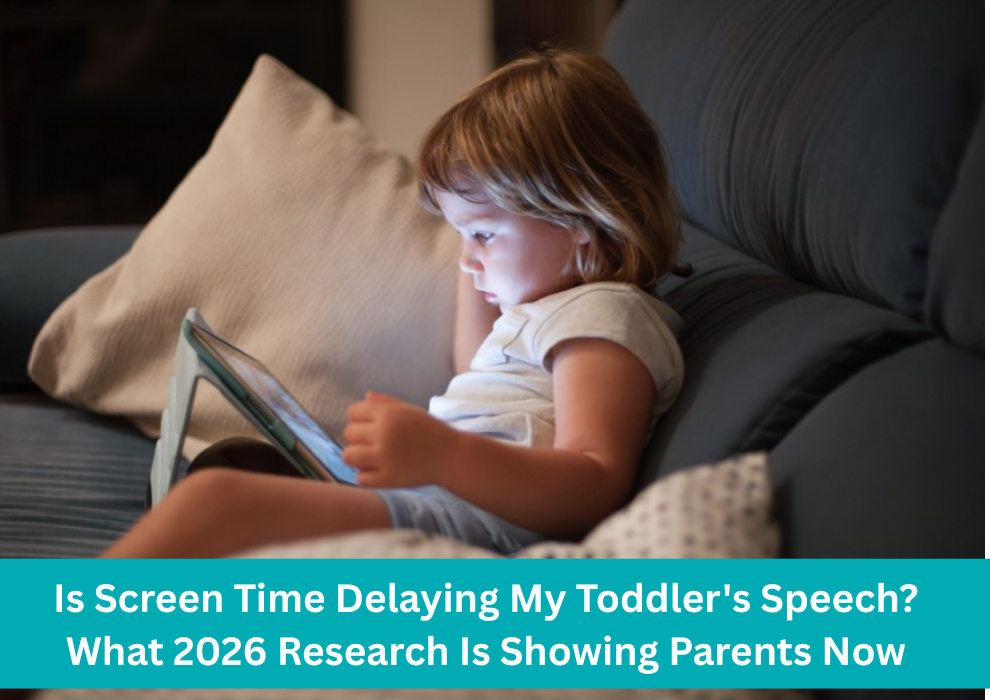
If you have noticed your toddler spending more time with a tablet or streaming videos and are wondering whether it is connected to slower speech development, you are asking exactly the right question. Research emerging through 2025 and into 2026 has continued to sharpen our understanding of how passive screen exposure interacts with early language acquisition and the findings are worth understanding properly, not through alarming headlines, but in clinical context.
Screen time does not directly cause speech delay — but replacing face-to-face conversation with passive screen exposure consistently slows language development in toddlers under three. The type of exposure, the amount, and what it replaces in your child’s day all matter more than the screen itself.
If you have immediate concerns about your toddler’s communication, our Does My Child Need Support? page is a helpful starting point before you read further.
What the 2026 Research Is Actually Saying
Research published in JAMA Pediatrics and the Journal of Child Language has consistently highlighted that back-and-forth conversation with a real adult remains the single most powerful driver of early language learning. A 2023 study by Chonchaiya and Pruksananonda (published in Acta Paediatrica) found that toddlers with more than 2 hours of daily television exposure were 6 times more likely to have a language delay than peers with lower exposure even after controlling for socioeconomic factors. More recently, Madigan et al. (2019, JAMA Pediatrics) confirmed in a longitudinal meta-analysis of 18 studies that higher screen time at 18 months was associated with significantly lower expressive language scores at age 3 to 5.
What is emerging specifically in 2026 is greater scrutiny of AI-powered children’s applications a category not covered by older research. These apps are marketed as interactive, but the social-emotional attunement they provide bears little resemblance to what a responsive caregiver delivers. Updated guidance from the American Academy of Pediatrics continues to recommend that video calling aside, screen use for children under 18 months provides no developmental benefit and should be avoided.
Key Insight: Passive screen exposure that replaces face-to-face conversation is the key risk factor for language delay not screen use in isolation. The evidence base for this is now robust across multiple international longitudinal studies.
Why Toddlers Learn Language Through Faces, Not Screens
Language acquisition in the first three years of life is a biologically sensitive process. Children learn words most efficiently when they can observe a speaker’s mouth, read facial expressions, hear the emotional tone of speech, and receive an immediate response to their own vocalisations. Screens are one-directional. A toddler watching a cartoon cannot ask it to repeat something, cannot receive praise for trying a new sound, and cannot engage in the kind of conversational turn-taking that builds syntax and vocabulary.
This is why the speech and language therapists at Esperanza now routinely map daily screen habits during every initial assessment. The presence of high screen time is not an automatic diagnosis, but it is meaningful clinical context that shapes the support plan. You can learn more about what our assessments involve on our Speech and Language Therapy service page.
Key Insight: Children learn language from people, not programmes. The relational context of communication is what drives development not content alone.
A parent may notice their two-year-old can press a button on a tablet to replay the same song dozens of times but does not attempt to communicate verbally during mealtimes or play. During a communication assessment at Esperanza, some children show strong receptive understanding of familiar media phrases while finding it difficult to use spontaneous words to express their own needs — before gradually developing richer verbal communication through structured play-based interaction and daily caregiver coaching at home.
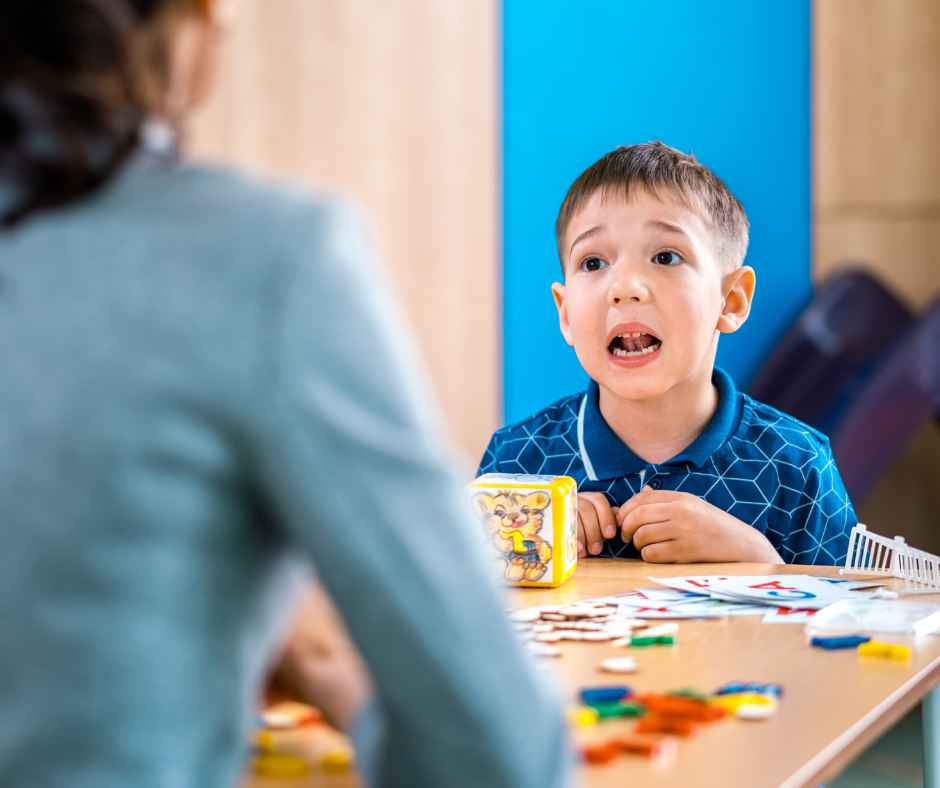
What Parents Can Do Right Now: Practical Steps at Home
There is no need to remove all screens immediately or to feel guilt about the past. The goal is to shift the balance over time so that interactive, conversational experiences take up more of your child’s day. These strategies are grounded in what speech and language therapists routinely recommend, and our Parent Training and Family Support programme can help you embed them into your daily routine with clinical guidance:
- Narrate your daily routines aloud. Getting dressed, preparing meals, and tidying up are all rich language opportunities when you describe what you are doing in simple, connected sentences.
- Pause and wait. When you ask your child a question or offer a choice, give them extended time to respond. Resist filling the silence.
- When screens are used, watch together and comment on what is happening. A caregiver narrating the video turns passive viewing into a shared conversational experience.
- Prioritise unstructured play with real objects and people. Toys that invite open-ended exploration generate far more communicative opportunity than screen-based games.
- Read physical books together daily. The lap-reading experience, with its shared attention, pointing, and responsive conversation, remains one of the most evidence-supported language-building activities available to families in any culture.
Key Insight: Narrating, pausing, and co-viewing with commentary turns everyday moments into powerful language-learning opportunities — and costs nothing.

When Should Parents Seek a Speech Assessment in Dubai?
If you have concerns about your child’s communication development, a formal assessment by a DHA-licensed speech and language therapist is the most reliable next step. Our First Steps Consultation is a free 60-minute session where a clinician observes your child and gives you clinical clarity. You do not need to wait until your child is three or four.
Consider requesting an assessment if your child at 18 months is not yet using 10 to 20 recognisable words, at 24 months is not combining two words into simple phrases, at any age is losing communication skills they previously had, or if you simply have a persistent parental instinct that something feels different. Families across Bur Dubai, Oud Metha, Karama, and Dubai Healthcare City regularly access our clinic on Zabeel Road for exactly this kind of early clinical conversation. You may also find it useful to read our related article on late talking versus early neurodivergence, which covers what a speech delay assessment looks at beyond vocabulary counts.
Key Insight: If you have any concern about your toddler’s communication development, seeking a professional opinion early is always the right decision. The neurological window for language development is widest before age three.
A Note on AI-Driven Learning Apps in 2026
The rise of AI-powered children’s applications has introduced a category of screen exposure that parents are navigating without much clinical guidance. Voice-interactive apps can feel educational because children engage with them verbally. However, these systems cannot adjust tone in response to a child’s mood, cannot read a child’s non-verbal signals, and cannot provide the moment-to-moment co-regulation that underpins language learning. For toddlers aged 0 to 3, the evidence still points clearly toward real human interaction as the primary vehicle for language development. For older children with established language skills, some applications offer genuine supplementary value but they should complement, not substitute for, human interaction.
Frequently Asked Questions
Q: Does watching YouTube actually delay speech in toddlers?
A: Passive, unsupervised viewing of fast-paced content reduces the time a toddler spends in face-to-face communication, which is where language learning happens. Research by Zimmerman et al. (2007, Archives of Pediatrics and Adolescent Medicine) found that for every additional hour of daily television viewing in children under 2, meaningful vocabulary words heard per hour dropped by over 7%. It is the displacement of interactive time, rather than the content itself, that carries the greatest clinical risk.
Q: My toddler understands everything but does not talk much. Is that still a concern?
A: Yes, this pattern is worth assessing. Strong receptive language alongside limited expressive language is a recognised clinical profile that speech therapists assess regularly. It is worth having a professional evaluation to understand the full picture and identify any specific support that could help.
Q: What is a safe amount of screen time for a 2-year-old?
A: The American Academy of Pediatrics recommends limiting recreational screen time to one hour per day for children aged 2 to 5, with a preference for high-quality, co-viewed content. For children under 18 months, the only recommended screen use is live video calling with family.
Q: Can a speech delay linked to screen time be reversed?
A: Language development is highly responsive to increased communicative experience. Research consistently shows that when families shift their routines to prioritise interactive engagement, and where targeted speech therapy support is introduced early, most children show meaningful progress. Early intervention consistently produces the strongest outcomes.
Q: Are AI learning apps safe for toddlers?
A: Current evidence does not support the use of AI-driven applications as primary language-learning tools for children under three. The social responsiveness that drives language acquisition is not replicated by current voice-interactive technology. Interactive human engagement remains the clinical gold standard.
Q: How do I know if my child needs a speech therapy assessment in Dubai?
A: If your child is not meeting communication milestones for their age, or if you have a persistent concern, a consultation with a DHA-licensed paediatric speech and language therapist is the right first step. Visit our Does My Child Need Support? page or WhatsApp our team directly.
If you have concerns about your child’s communication development or would like to understand whether a speech assessment is the right next step, the team at Esperanza is here to help. WhatsApp us at 00971 55 5241094 to book your free First Steps Consultation.
Esperanza Speech and Occupational Therapy Centre — Office 42B, Zomorodah Building B Block, near Central Post Office, Al Karama, Dubai, UAE. View on Google Maps