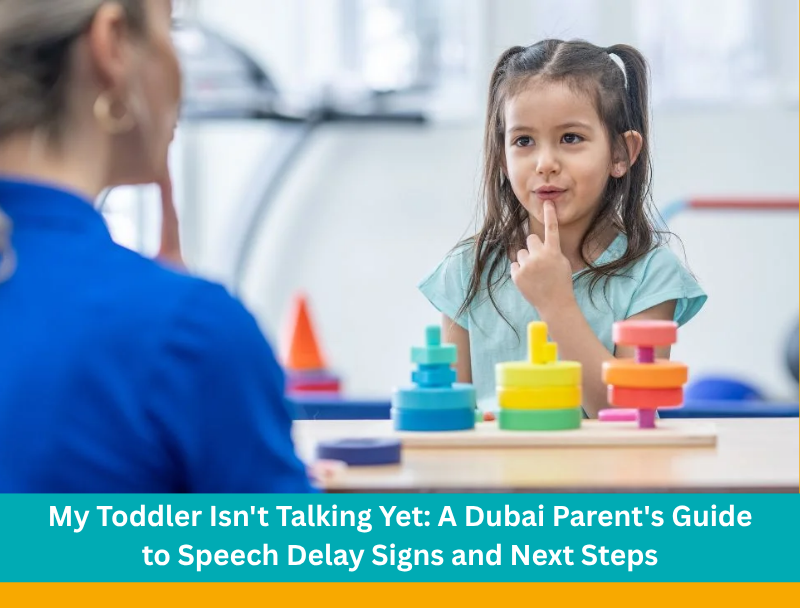
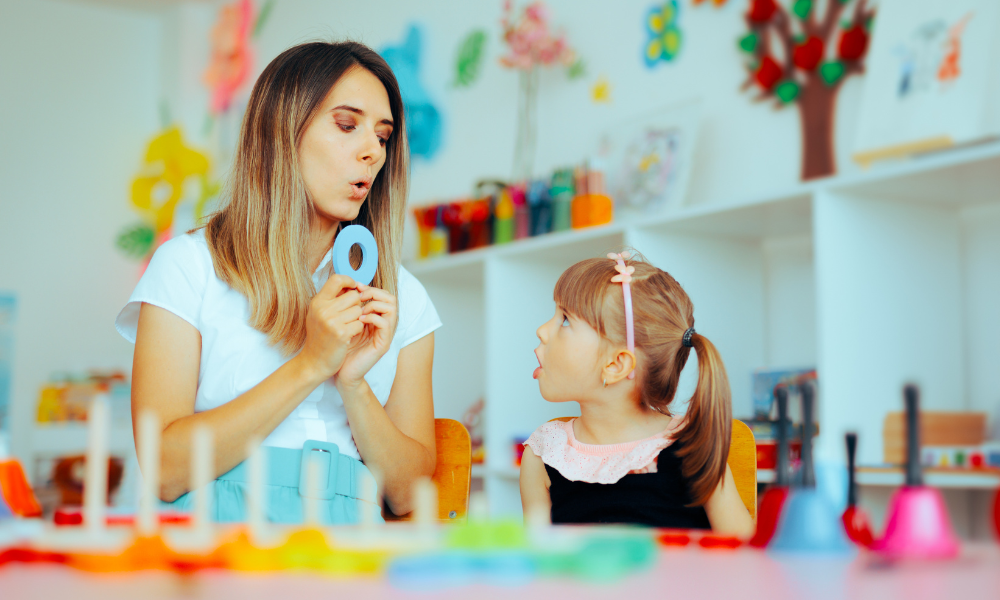
A mum from Oud Metha recently described the moment she started to worry. Her two-year-old daughter would babble happily all day pointing at things, following instructions, laughing at the right moments but the words simply weren’t coming. ‘I Googled it at midnight,’ she told us. ‘One article said she was fine. The next one listed twelve red flags. I closed my laptop more confused than when I started.’
If that sounds familiar, you are not alone.
Parents across central Dubai in Karama, Downtown, Al Jaddaf, and along Sheikh Zayed Road are navigating the same uncertainty every day. The internet offers endless information and very little reassurance. Well-meaning relatives offer conflicting advice. And somewhere underneath it all is a quiet question that every parent carries: “Is my child okay?”
This guide is designed to answer that question honestly, clearly, and without alarm. It won’t replace a professional assessment, but it will give you something far more useful than another late-night search: a clear picture of what speech and language development actually looks like, age by age, and what it means if your child is sitting slightly outside those markers.
Speech & Language Milestones: Ages 1 to 5
The table below shows what most children are doing at each age stage. Use it as a guide, not a verdict. The signal column, green, amber, or red, tells you how to interpret where your child sits.
| On Track | Milestone met keep encouraging language-rich play |
| Worth Watching | Not alarming, but worth monitoring over the next 4–6 weeks |
| Seek Advice | Book a consultation with a speech-language therapist |
| Age | Words / Sentences | Understanding | Clarity |
|---|---|---|---|
| 12 months | 1–3 words (e.g. ‘mama’, ‘dada’, ‘no’). Lots of babbling with varied sounds. | Responds to own name. Understands simple instructions like ‘No’. | Not expected to be clear yet. |
| 18 months | 10–20 words. May start combining two words (‘more milk’, ‘daddy go’). | Follows simple 2-step instructions. Points to body parts when named. | Family understands most words. |
| 2 years | 50+ words. Uses 2-word phrases consistently (‘big dog’, ‘go park’). | Understands simple questions. Follows 2-step instructions routinely. | Strangers understand about 50% of speech. |
| 3 years | 200–300 words. Uses 3–4 word sentences. Asks simple questions (‘Where ball go?’). | Understands ‘who’, ‘what’, ‘where’. Follows 2–3 step instructions. | Strangers understand about 75% of speech. |
| 4 years | Tells simple stories. Uses 4–6 word sentences. Uses past tense. | Understands ‘why’ and ‘how’. Follows complex multi-step directions. | Most speech is clear to strangers. |
| 5 years | Uses full sentences. Retells stories with beginning, middle, and end. | Understands time concepts (yesterday, tomorrow). Follows classroom instructions. | Speech is fully intelligible to all listeners. |
Quick Answers for Parents
| Q: Is it normal for a 2-year-old not to talk? |
| By age two, most children have around 50 words and are starting to combine two words together (like ‘more juice’ or ‘daddy go’). If your 2-year-old has fewer than 50 words, or isn’t yet putting words together, it is worth seeking a professional opinion. This doesn’t mean something is wrong but early support makes a significant difference, and a brief consultation will either reassure you or connect you with help at exactly the right time. |
| Q: Does growing up bilingual cause speech delay? |
| No, this is one of the most common misconceptions we hear from families in Dubai. Bilingual children may sometimes switch between languages, and their vocabulary in each individual language may appear smaller compared to a monolingual child. However, when both languages are considered together, their overall vocabulary is typically within the expected range for their age.Research consistently shows that bilingualism does not cause speech or language delays. In fact, learning two languages is a natural and beneficial part of development for many children.Concern is only warranted if a child is experiencing difficulties across all languages they are exposed to. In such cases, it is helpful to seek professional guidance to better understand their communication development. |
| Q: When should I worry about my child’s speech? |
| Trust your instincts. If your child shows any of the following signs, it may be helpful to seek a consultation:Not babbling by around 12 months Having fewer than 10 spoken words by 18 months Not combining two words by age 2 Speech that is difficult for unfamiliar adults to understand by age 3 Appearing noticeably behind peers in nursery settings These are early indicators that a developmental check can provide clarity and guidance.An assessment does not mean starting therapy. It is simply an opportunity to understand your child’s communication development better and to decide on the most appropriate next steps, if needed. |
How to Track Your Child’s Speech at Home
You don’t need to be a therapist to notice meaningful things about your child’s communication. Here are two simple checklists you can screenshot or print one for children around 18 months to 2 years, and one for children approaching 3 to 4 years.
| Checklist: 18 months to 2 years |
| ☐ Does your child point to things they want or find interesting? |
| ☐ Does your child respond to their name consistently? |
| ☐ Does your child follow simple instructions (‘Give me the ball’, ‘Come here’)? |
| ☐ Does your child use at least 10 clear words? |
| ☐ Does your child try to get your attention using sounds or gestures? |
| ☐ Is your child starting to put two words together (‘more milk’, ‘no daddy’)? |
| Checklist: 3 to 4 years |
| ☐ Does your child use short sentences (3+ words) most of the time? |
| ☐ Can unfamiliar adults understand most of what your child says? |
| ☐ Does your child ask questions (‘What is that?’ / ‘Where are we going?’)? |
| ☐ Does your child follow two-step instructions without needing a gesture? |
| ☐ Does your child enjoy books, stories, and conversations? |
| ☐ Is your child making friends and communicating at nursery or playgroups? |
Why Early Support Makes Such a Difference
The first five years of life are a critical period for language acquisition. The brain during these years is extraordinarily responsive neural pathways for language are forming rapidly, and the right support during this window can make a significant, lasting difference.
Research published across leading speech-language journals consistently shows that children who receive early speech therapy intervention particularly before age three achieve better language outcomes than those who receive the same support later. This isn’t cause for alarm; it is simply an argument for acting on curiosity rather than waiting for certainty.
In Dubai’s competitive nursery and school landscape, particularly around Trade Centre, Downtown, and the areas along Sheikh Zayed Road, school readiness expectations are significant. A child who enters nursery with strong communication foundations will navigate social situations, classroom instructions, and friendships with greater confidence.
A Note for Dubai Families — You’re Navigating Something Unique
Dubai is not a typical city for raising young children, and the families we work with at Esperanza know this well. Many parents in Karama and Oud Metha are raising their children in households where two, three, or even four languages are spoken Arabic at grandma’s, English at nursery, Hindi at home, and Tagalog with the nanny. Families near Al Jaddaf and Trade Centre are often managing demanding careers alongside parenting, meaning early signs can be easy to miss in the rush of daily life.
Parents living near Downtown Dubai and along Sheikh Zayed Road frequently mention the pressure of nursery admissions and school readiness timelines and the very understandable anxiety that comes when a child seems to be developing differently from peers in the same class.
We want to say this clearly: navigating all of this does not make your concerns any less valid. It makes them more understandable. And getting some professional perspective even just a conversation is one of the most grounded, proactive things a parent can do.
What You Can Do at Home Right Now
You don’t need special training to support your child’s language development. The most powerful tools are already in your daily life they just need a little intentionality.
- Talk about everything you’re doing. ‘I’m cutting the apple. Red apple. Round apple.’ Running commentary isn’t silly it’s one of the most evidence-backed ways to build vocabulary.
- Read together every day. Even ten minutes of shared book time exposes children to sentence structures and vocabulary that everyday conversation doesn’t always include.
- Follow your child’s lead. If they’re fascinated by a toy car, talk about the car. Language learning is far more efficient when it connects to a child’s own interests.
- Reduce screen time for under-twos. Screens deliver language passively; real interaction delivers it actively. The difference in acquisition is substantial.
- Respond to babbles and gestures. When your baby points at the dog, say ‘Yes! Dog! Big dog!’ This turn-taking is the foundation of conversational language.
- Ask open questions. Instead of ‘Do you want juice?’ try ‘What do you want to drink?’ even if they can only point you’re modelling the expectation of a verbal response.
When to Seek Professional Support
There is no perfect moment to book a consultation but there are clear signals that it’s the right time. Here are six indicators to look out for. These are not reasons to panic; they are reasons to gather information.
- Your child is not meeting the milestones in the table above at their current age stage.
- You notice a plateau your child was making progress and has now stopped for four weeks or more.
- Other adults (nursery teachers, grandparents, friends) are commenting on your child’s communication.
- Your child is becoming frustrated during interactions hitting, withdrawing, or avoiding conversation.
- Your child’s speech is not becoming clearer over time, or is significantly harder to understand than peers the same age.
- Your gut is telling you something is worth checking and it has been for a while.
How Esperanza Supports Families Like Yours
At Esperanza Speech and Occupational Therapy Centre in Dubai, we work with children and families every day who arrive exactly where you are right now curious, caring, and looking for clarity.
| Speech & Language Therapy: Evidence-based, play-led sessions tailored to each child’s needs. We work on articulation, vocabulary, sentence structure, and social communication always in partnership with parents. | Occupational Therapy: Supporting children with sensory processing, fine motor skills, and daily living activities. Especially helpful when speech concerns come alongside sensory sensitivity or motor delays. |
| Comprehensive Assessments: Our assessments give you a clear picture of where your child is and what support, if any, would help them. No jargon, no alarm just honest, professional clarity. | Parent Coaching: You are your child’s most important communication partner. Our parent coaching sessions equip you with practical, evidence-based strategies to use at home every single day. |
Your Next Step — When You’re Ready
You’ve made it through the whole guide which tells us something. You’re paying attention. You’re curious. You’re the kind of parent who checks.
You can schedule a consultation with Esperanza Speech and Occupational Therapy Centre at a time that suits you. We support families across central Dubai, including Karama, Oud Metha, Al Jaddaf, Trade Centre, Downtown Dubai, Sheikh Zayed Road, and Al Hudaiba.
WhatsApp: 0555241094
There is no obligation or pressure, just a supportive conversation to help you understand your child’s needs and the next steps clearly.