One of the most common questions parents ask when a toddler is not yet speaking as expected is whether the delay is simply a matter of timing, or whether it signals something more about how their child’s brain is developing. It is a deeply understandable question, and in 2026, it is one that paediatric clinicians are better equipped to explore than ever before.
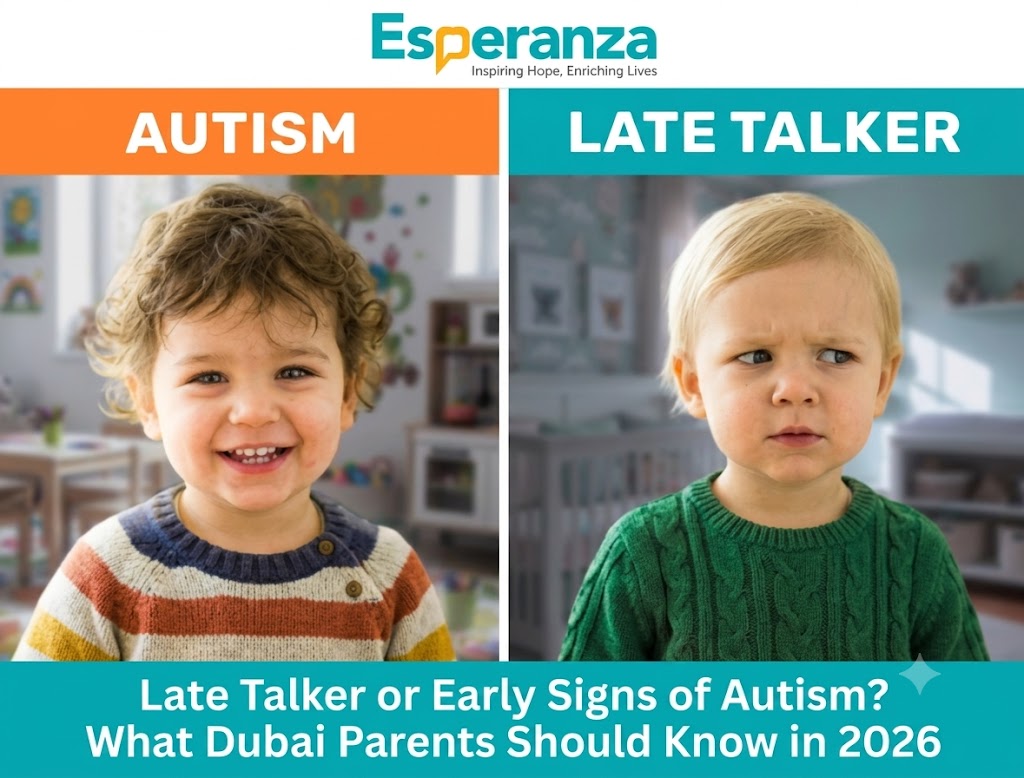
A late talker is a child whose expressive vocabulary is delayed but whose social communication, joint attention, play skills, and comprehension are broadly typical. Early autism is characterised not only by delayed speech but by differences in how a child uses communication socially — including reduced joint attention, limited pointing, and inconsistent response to their name. These distinctions matter because they point toward very different clinical pathways.
Our Common Concerns and How We Support You page addresses many of the questions families bring to us for the first time. If you are also wondering whether screen time may have played a role in your child’s delayed speech, our earlier article on screen time and toddler speech development provides useful context.
What Is a Late Talker?
A late talker is typically defined as a toddler who is developing within expected ranges across most areas social engagement, play, comprehension, motor development — but whose expressive vocabulary is behind what is expected for their age. At 24 months, most children are using around 50 or more words and beginning to combine them into two-word phrases. A child who is not reaching these markers without other developmental concerns is often described as a late talker.
Importantly, many late talkers do catch up without formal intervention, particularly when they have strong comprehension, are engaged socially, and are developing play skills typically. However, Paul et al. (2018, in the Journal of Speech, Language, and Hearing Research) found that approximately 25 to 30 percent of children identified as late talkers at age 2 continue to experience language difficulties into school age — a significant proportion that underlines why monitoring and early assessment are always worthwhile, not alarmist.
Key Insight: Late talking alone is not diagnostic — but it is always a signal worth taking seriously with a professional assessment rather than a ‘wait and see’ approach alone.
Early Neurodivergence: What Clinicians Are Looking For in 2026
The term neurodivergence encompasses a range of neurological differences including autism spectrum conditions, ADHD, developmental language disorder, and others. Early markers that clinicians assess alongside expressive language include: how a child uses eye contact in social interactions; whether they point to share interest in objects or events (declarative pointing); how they engage in joint attention with a caregiver; the presence of repetitive movements or highly specific interests; how flexibly they move between activities; and whether they respond to their name consistently. You can read about the specific conditions we support on our Autism and ADHD condition pages.
It is important to understand that these markers are not a checklist that produces a binary yes or no answer. Zwaigenbaum et al. (2015, Pediatrics) identified that the reliability of autism-specific behavioural markers increases significantly after 14 months, but that a skilled clinician uses the full developmental profile, not single indicators, to guide assessment decisions. Development is dynamic, context-dependent, and influenced by temperament, bilingual environments, and individual variation.
Key Insight: The key clinical distinction lies not just in how many words a child uses, but in how they use communication socially — and what accompanies the language pattern across the full developmental picture.
Why Earlier Screening Is Changing Outcomes in 2026
One of the most significant shifts in paediatric developmental practice in recent years is the emphasis on earlier and more accessible screening. Dawson et al. (2010, Child Development) demonstrated that intervention initiated before 30 months in autistic children produced significantly greater gains in cognitive ability, language, and adaptive behaviour than intervention begun later. This is the neurological foundation of our Early Intervention model at Esperanza.
In Dubai, increased awareness among nursery educators, paediatricians, and families has led to more children being referred for developmental assessment before school entry. Esperanza’s location on Zabeel Road, close to several of Dubai’s established nursery and early childhood education communities across Oud Metha, Karama, and Dubai Healthcare City, means the team works regularly with families who are navigating exactly this kind of early uncertainty — often within weeks of a nursery raising a concern.
Key Insight: Earlier referral for developmental assessment means children receive appropriate support during the years when neurological plasticity is at its greatest. The evidence for earlier intervention producing better long-term outcomes is now extensive.
A parent may notice their two-and-a-half-year-old has very few words but is intensely interested in a narrow range of objects and becomes very distressed when routines change. During an initial developmental consultation at Esperanza, some children show a nuanced profile that includes both language differences and social communication patterns that warrant further multidisciplinary assessment — before receiving a personalised family support plan that addresses their specific developmental picture.
What Happens During a Developmental Screening Assessment at Esperanza?
A paediatric developmental assessment at Esperanza begins with a free First Steps Consultation a 60-minute session where a DHA-licensed therapist listens to the family’s observations, reviews developmental history, and observes the child in structured and unstructured play. A formal assessment follows if indicated, examining both expressive and receptive language, play skills, social attention, and interaction quality.
Where the profile suggests broader developmental differences, an Occupational Therapy assessment may run alongside to examine sensory processing, motor development, and self-regulation. If sensory or emotional regulation difficulties are also part of what the family describes, our article on school refusal and the sensory link may also be relevant context. Following assessment, families receive a clear written clinical summary with practical guidance and referral pathways where relevant.
Key Insight: A good developmental assessment tells a child’s story from multiple angles — not just how many words they say, but how they use those words, how they play, and how they connect.
Should I Wait and See, or Seek Assessment Now?
The clinical guidance in 2026 is consistent: if you have a concern, there is no developmental advantage to waiting. The American Academy of Pediatrics recommends autism-specific screening for all children at 18 and 24 months regardless of whether concerns are present, precisely because early identification is most impactful during the neurologically sensitive period. Our Process page explains exactly how an assessment at Esperanza works, from the first WhatsApp message through to the support plan.
Key Insight: Seeking a developmental assessment early is always appropriate. The question is never whether you acted too soon — only whether the timing gave your child the best possible start.
Frequently Asked Questions
Q: My child says a few words but does not really use them to communicate. Is that a concern?
A: Yes, this pattern is worth assessing. Using words functionally to request, comment, and connect with others is distinct from simply producing sounds. Our Speech and Language Therapy team can help you understand what your child’s communication profile looks like and what it means clinically.
Q: Can a child be a late talker and also autistic?
A: Yes. These are not mutually exclusive. Some autistic children are late talkers and some are not. A thorough developmental assessment considers the full range of a child’s developmental skills, not speech alone.
Q: At what age is it most effective to seek early intervention for autism?
A: Research consistently shows that intervention beginning before the age of three, during the period of highest neurological plasticity, is associated with the most significant developmental outcomes (Dawson et al., 2010). Our Early Intervention programme is designed specifically for this critical window.
Q: What is the difference between autism and ADHD in toddlers?
A: Both can involve attention and communication differences, but the underlying profiles differ. ADHD tends to present with hyperactivity, impulsivity, and sustained attention difficulties. Autism typically involves differences in social communication and often includes sensory sensitivities and restricted interests. A multidisciplinary assessment helps distinguish these profiles where needed, and both are conditions we support at Esperanza.
Q: My child’s nursery has suggested a developmental assessment. Should I be worried?
A: A nursery raising a developmental concern is doing exactly what a good early childhood setting should do. Our Common Concerns page addresses this situation directly and explains what a first assessment at Esperanza involves in practical terms.
Q: Can bilingualism make a child look like a late talker?
A: Yes. Bilingual and multilingual children may distribute their vocabulary across languages, meaning that counting words in one language alone underestimates their total communication competence. Our team has extensive experience assessing children from Dubai’s multicultural and multilingual families, and we assess across languages where relevant.
Q: What should I bring to a first developmental assessment appointment?
A: Bring any reports from nursery or previous professionals, a brief list of the words and phrases your child uses, information about your family’s language environment, and any short videos of your child communicating at home. Videos from natural home settings are particularly useful.
Every child’s developmental journey is different. If you are wondering whether your toddler’s communication and development are on the right path, Esperanza’s paediatric team is here to help you find clarity. WhatsApp us at 00971 55 5241094 to learn more about how we work.
Esperanza Speech and Occupational Therapy Centre — Office 42B, Zomorodah Building B Block, near Central Post Office, Al Karama, Dubai, UAE. View on Google Maps