
If Monday mornings have become a battleground in your home if your child melts down at the school gate, complains of stomach aches that disappear by mid-morning, or simply refuses to go in you are not alone. School refusal and pre-school emotional dysregulation are among the most distressing experiences for families, and in 2026, clinicians are increasingly recognising a key factor that often goes unidentified: sensory processing differences.
When a child’s nervous system is hypersensitive to sensory input — sound, light, touch, smell, or unpredictable transitions — the classroom environment can exceed their regulatory capacity before the school day has even begun. What presents as defiance, anxiety, or avoidance is often a nervous system response to genuine physiological overwhelm. Addressing the sensory dimension can be the turning point that no amount of boundary-setting alone will reach.
Our Occupational Therapy team at Esperanza specialises in exactly this kind of sensory-informed assessment and support. If you are also wondering whether an underlying neurodevelopmental difference may be contributing to your child’s school difficulties, our article on late talking versus early neurodivergence provides relevant clinical context.
What Is Sensory Processing and Why Does It Matter in School?
Sensory processing refers to the way a child’s nervous system receives, interprets, and responds to sensory input from their environment. Ayres (1972) first described Sensory Integration theory — the foundational framework for understanding how the brain organises and uses sensory information to produce adaptive responses. For children with sensory processing differences, this integration process works differently, often resulting in either over-responsivity (hypersensitivity) or under-responsivity (hyposensitivity) to one or more sensory systems. You can read a detailed clinical overview on our Motor and Sensory Disorder conditions page.
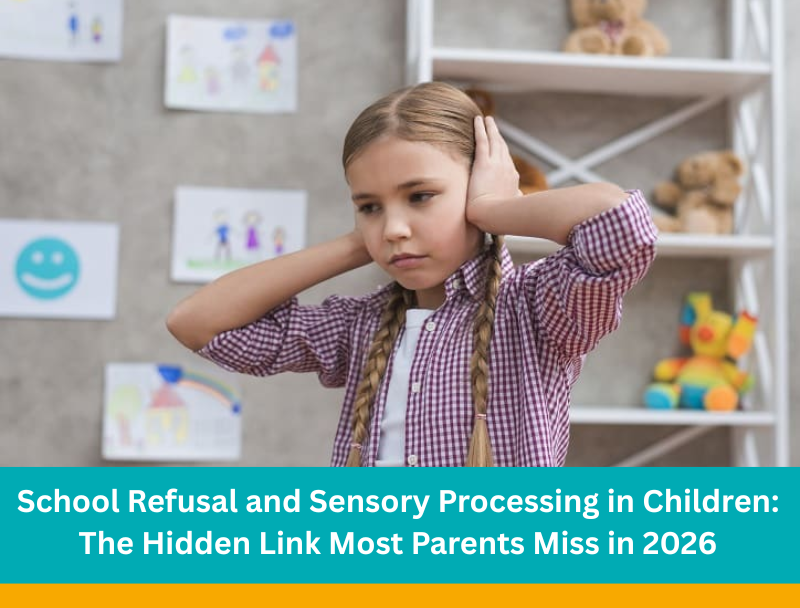
A classroom is an extraordinarily sensory-rich environment. Fluorescent lighting, background noise from other children, the texture of a uniform, the smell of the canteen, the unpredictability of a busy corridor at transition time each of these is a layer of sensory input that a child’s nervous system must process alongside the cognitive and social demands of being at school. For a child whose nervous system is highly reactive, this accumulation can reach a threshold that triggers genuine physiological distress. What looks from the outside like resistance or defiance is often the outward expression of a nervous system that is overwhelmed.
Key Insight: School refusal linked to sensory processing is not wilful misbehaviour. It is a nervous system response to an environment that feels genuinely overwhelming — and it requires a sensory solution, not just a behavioural one.
The Signs That Sensory Processing May Be Driving School Refusal
Not every child who refuses school has a sensory processing difference, and not every child with sensory differences refuses school. But the following patterns, particularly when they cluster together, are worth bringing to a clinician’s attention:
- Meltdowns that begin in the morning routine before the child even reaches school often triggered by clothing, breakfast textures, or noise during getting ready.
- Physical complaints such as stomach aches, headaches, or nausea that resolve once the pressure of going to school is removed.
- Extreme fatigue after school sometimes described by parents as an inability to function in the afternoon as the child has spent significant regulatory energy throughout the day.
- Intense distress at specific elements of the school day such as assembly, the dining hall, PE changing rooms, or playground noise.
- A child who was managing school but suddenly deteriorates as academic and social demands increase often at a year-group transition.
- Difficulty transitioning between activities, rigidity around routine, and intense reactions to unexpected changes at home or at school.
Key Insigt: A cluster of morning distress, physical complaints, and post-school exhaustion often points to sensory regulation demands that exceed a child’s current capacity not a motivational or behavioural problem.
How Occupational Therapy Addresses the Sensory Dimension of School Refusal
Paediatric occupational therapists with training in sensory integration are skilled at mapping a child’s sensory profile understanding which sensory systems are hypersensitive or hyposensitive, and how the individual’s nervous system signature interacts with the demands of their daily environment. Miller et al. (2007, in The American Journal of Occupational Therapy) provided an influential nosological framework for sensory processing subtypes that remains clinically relevant in 2026. Our School Assessments service at Esperanza is specifically designed to provide schools with clinically grounded reports that translate sensory findings into practical classroom recommendations.
Following a sensory assessment, an OT develops a personalised sensory regulation toolkit often called a sensory diet that helps the child’s nervous system arrive at school in a calmer, more organised state. Our Behaviour Therapy team also works alongside OT where emotional regulation difficulties are a significant part of the picture.
Key Insight: A sensory profile assessment gives families and schools the specific information they need to make the school environment genuinely accessible — not by lowering expectations, but by understanding and addressing what is getting in the way.
A parent may notice that their seven-year-old is inconsolable every Sunday evening and refuses to eat breakfast on school days, but seems relaxed and engaged at home and at weekend activities. During an occupational therapy assessment at Esperanza, some children show a sensory profile characterised by high auditory sensitivity and difficulty with unpredictable transitions, before working with their therapist, family, and school SENCO to introduce targeted sensory regulation strategies and a modified arrival routine that significantly reduces morning distress within a few weeks.
Emotional Dysregulation: When Feelings Become Overwhelming
Emotional regulation the ability to manage the intensity, duration, and expression of emotional responses develops gradually across childhood. It depends on neurological maturation, secure attachment, consistent co-regulation from caregivers, and a sensory nervous system that can tolerate the demands of the child’s environment.
Children who are experiencing sensory overload are, by definition, operating with an already-stressed nervous system. Their capacity for emotional regulation in this state is genuinely reduced. This is the neurological foundation of supporting these children effectively, and it is why our Parent Training and Family Support programme places such emphasis on co-regulation skills for caregivers. When families understand what is happening neurologically, they become far more effective partners in their child’s regulation journey at home and in communication with schools.
Key Insight: Emotional dysregulation in children is almost never purely behavioural. Sensory, neurological, and attachment factors are almost always part of the picture — and addressing them requires a different approach than behaviour management alone.

How Dubai Schools Can Support Sensory-Sensitive Children
Dubai’s school landscape includes a wide range of settings international schools, GEMS schools, curriculum-specific institutions, and Arabic medium schools each with varying levels of awareness around sensory processing and inclusion. In our experience working with families whose children attend schools near Oud Metha, Dubai Healthcare City, Zabeel Road, and Karama, the schools that produce the best outcomes for sensory-sensitive children share certain characteristics.
They are willing to implement relatively simple environmental modifications: providing a quieter arrival space, allowing a sensory-sensitive child to leave assembly early, permitting an alternative seating option in class, or agreeing to a brief movement break between activities. These are not accommodations that require significant resources. They require understanding.
An OT report from Esperanza gives the school language it can act on. Our School Assessments reports are specifically formatted for sharing with SENCOs, head teachers, and inclusion coordinators. We work collaboratively with schools across Dubai to ensure recommendations are realistic within the school’s operational context and that families do not have to fight to be heard.
Key Insight: In Dubai’s school environment, a well-written OT report is often the most effective advocacy tool a family can bring to a school meeting. It translates a child’s sensory experience into actionable classroom accommodations.
What Parents Can Do: Starting Points at Home
- Predictable morning routines reduce transition stress. Use visual schedules where helpful so that each step of the morning is known and anticipated by the child.
- Reduce sensory demands where you can. If a particular uniform item is a consistent trigger, investigate whether the school can accommodate an alternative material many Dubai schools will consider this with appropriate clinical documentation.
- Regulate yourself first. A co-regulated adult is the most powerful tool in supporting a dysregulated child. Your calm, consistent presence genuinely matters at a neurological level.
- Avoid engaging in debates or ultimatums during a meltdown. The child’s thinking brain is offline during intense dysregulation. Connection and co-regulation come first; problem-solving comes later.
- Communicate with the school proactively. Ask specifically about sensory environments, transition points, and whether a quieter arrival option is available.
- Name what you see without judgement. Saying ‘it sounds like the noise in the dining hall feels really loud and horrible for you’ validates your child’s experience and builds the emotional vocabulary they need over time.
Key Insight: Co-regulation from a calm, predictable caregiver is the most powerful short-term tool available to parents supporting a dysregulated child — and it is free, immediate, and available in every context.
When to Seek Professional Support
If school refusal has been going on for more than two to three weeks, is worsening despite home strategies, or is significantly affecting your child’s wellbeing and education, a paediatric occupational therapy assessment is the appropriate next step. Our First Steps Consultation is free and provides immediate clinical clarity on whether sensory processing is a contributing factor. In some cases, a multidisciplinary approach involving both Occupational Therapy and Speech and Language Therapy is indicated particularly where communication difficulties, social anxiety, or broader developmental differences are also present. If you suspect an underlying neurodevelopmental difference may be part of the picture, our article on late talking and early neurodivergence is a useful companion read.
Key Insight: Two or more weeks of persistent, worsening school refusal is a clear signal to seek a paediatric occupational therapy assessment — not to escalate behavioural consequences.
Frequently Asked Questions
Q: Is school refusal always related to sensory processing?
A: No. School refusal has multiple possible drivers including anxiety, social difficulties, bullying, learning differences, and family circumstances. Sensory processing is one important factor to explore, particularly when physical complaints, morning meltdowns, and sensory-related triggers are present. A clinical assessment distinguishes between these drivers.
Q: What is a sensory diet and does it actually work?
A: A sensory diet is a personalised schedule of sensory activities designed by an OT to help regulate a child’s nervous system throughout the day. Wilbarger (1995) coined the term, and subsequent research including Case-Smith and Bryan (1999) supports the effectiveness of sensory-based intervention when tailored to the child’s specific sensory profile and implemented consistently.
Q: My child’s school says he just needs firmer boundaries. Could that be right?
A: Firm and consistent boundaries are important for all children. However, when emotional dysregulation is driven by sensory or neurological factors, boundary-setting alone is unlikely to resolve the underlying difficulty — and may increase distress if the child is already in a state of sensory overwhelm. A clinical assessment provides clarity on what is actually driving the behaviour before deciding on the intervention approach.
Q: At what age can a sensory assessment be done?
A: Sensory assessments can be conducted from toddlerhood onward. Our Occupational Therapy team at Esperanza has experience assessing children from early childhood through to adolescence. The earlier a child’s sensory profile is understood, the earlier appropriate environmental and therapeutic support can be put in place.
Q: Can occupational therapy help with school refusal directly?
A: Where sensory processing differences are a significant contributing factor, occupational therapy addressing the sensory and regulatory aspects of the child’s profile has clear clinical support for improving school tolerance and daily wellbeing. The intervention works most effectively when combined with school-level environmental modifications and family co-regulation coaching.
Q: What should I tell my child’s school about sensory processing?
A: An OT assessment report from Esperanza provides specific, school-facing language and practical recommendations. Our School Assessments reports are specifically formatted for sharing with SENCOs, head teachers, and inclusion teams across Dubai schools.
Q: How long does improvement take with sensory-informed support?
A: This varies depending on the child’s profile, the consistency of implementation, and environmental factors. Many families notice meaningful change in the morning routine and emotional regulation within four to eight weeks of consistent sensory strategies though ongoing support often continues beyond this as the child’s demands evolve through school years.
If your child is struggling with school, emotional meltdowns, or sensory overwhelm and you would like to understand what is happening from a clinical perspective, Esperanza’s occupational therapy team is here to help. WhatsApp us at 00971 55 5241094 to book a free First Steps Consultation.
Esperanza Speech and Occupational Therapy Centre — Office 42B, Zomorodah Building B Block, near Central Post Office, Al Karama, Dubai, UAE. View on Google Maps