A hearing loss diagnosis is one of those moments that reorganises everything. The world you knew before the appointment is the same world you walk back into afterwards, but it feels different. And now, alongside the weight of the news itself, you are being introduced to a set of decisions you never expected to be making.
Hearing aid or cochlear implant. What is the difference? How does anyone know which is right? And once a device is chosen, what happens next?
This guide answers those questions in plain, honest language. It explains how each device works, what factors determine which pathway is appropriate, and how speech and language therapy is adapted to each. It is written for parents who are in the earliest stages of this journey, before any device decision has been made, and who need clarity rather than more complexity.
If you would like to speak with someone who understands this process in a Dubai context, our First Steps consultation is a gentle starting point with no obligation.
1. How a Hearing Aid Works and Who It Is Designed For
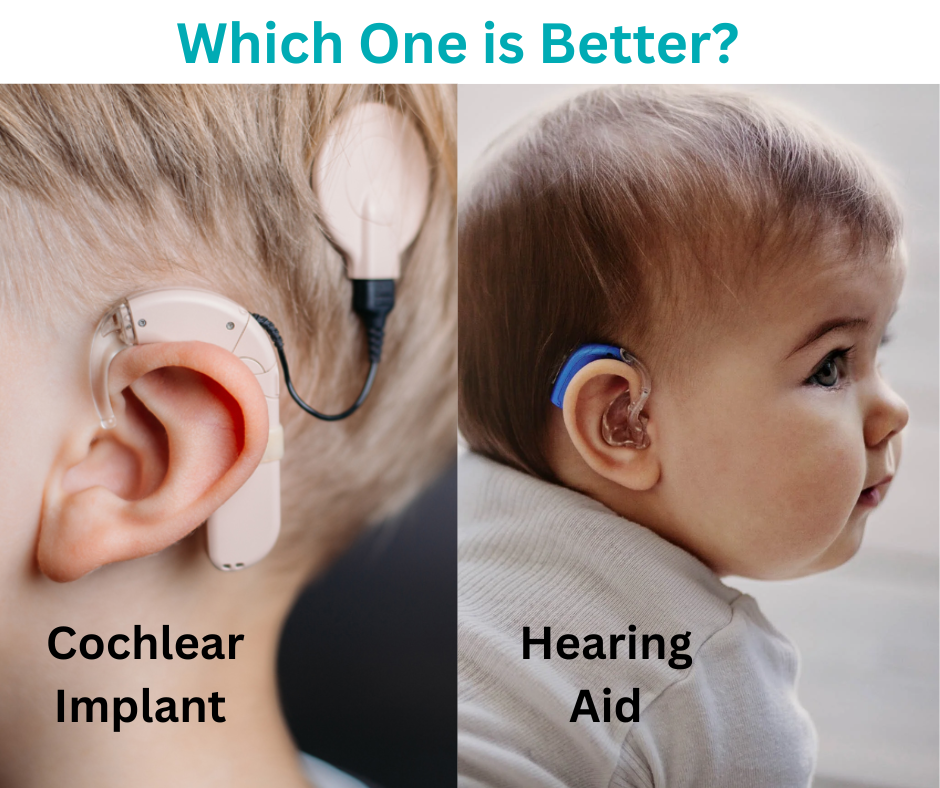
A hearing aid is an electronic device worn in or behind the ear that picks up sound from the environment, processes it, and amplifies it. The amplified sound is then delivered through the ear canal to the cochlea, which is the hearing organ in the inner ear.
For a hearing aid to be effective, the cochlea must retain enough function to convert the amplified sound into electrical signals for the brain to process. This is why hearing aids are suited to children with mild, moderate, or severe hearing loss: there is enough inner ear function remaining for the amplified signal to produce meaningful auditory input.
Hearing aids can be fitted from a few weeks of age once hearing loss is confirmed by diagnostic testing. Modern paediatric hearing aids are small, sophisticated, and capable of remarkable sound processing, including noise reduction, directional microphones, and wireless connectivity. They do not require surgery and can be adjusted as a child’s hearing profile changes over time.
Consistent wearing during all waking hours is the foundation of everything that follows. A hearing aid that is not worn is not providing the auditory input the brain needs.
| Key Insight: A hearing aid amplifies sound and delivers it to a functioning inner ear. It is suited to mild to severe hearing loss and can be fitted from a few weeks of age with no surgery required. |
2. How a Cochlear Implant Works and Who It Is Designed For
A cochlear implant takes a fundamentally different approach. Rather than amplifying sound and sending it through the ear canal, it bypasses the damaged cochlea entirely and delivers electrical signals directly to the auditory nerve.
The system has two parts. The internal component is surgically implanted and includes an electrode array placed inside the cochlea. The external component is a sound processor worn on or behind the ear, which captures sound, converts it to a coded signal, and transmits it across the skin to the internal implant. The implant then stimulates the auditory nerve, which sends signals to the brain for processing.
Cochlear implants are designed for children with profound hearing loss, or for children with severe hearing loss who have trialled well-fitted hearing aids without achieving sufficient speech understanding. They provide access to a much wider range of sounds than a hearing aid can offer for these degrees of loss.
Surgery is typically considered from nine to twelve months of age, though the assessment and candidacy process begins earlier. Children who are implanted in the first year of life and who begin cochlear implant therapy promptly after activation have the best access to the brain’s most plastic developmental window.
| Key Insight: A cochlear implant bypasses the damaged inner ear and delivers electrical signals directly to the auditory nerve. It is used for profound hearing loss or severe loss where hearing aids provide insufficient benefit. |
3. Side-by-Side Comparison: The Key Differences
The table below summarises the key practical differences between hearing aids and cochlear implants for parents who are making sense of these two pathways for the first time.
| Hearing Aid | Cochlear Implant | |
| How it works | Amplifies sound and delivers it through the ear canal to the inner ear | Bypasses the damaged inner ear and sends electrical signals directly to the auditory nerve |
| Best suited for | Mild to severe hearing loss where the inner ear retains some function | Profound hearing loss or severe loss where hearing aids provide insufficient benefit |
| Fitted by | Audiologist (no surgery required) | Surgical procedure followed by audiologist programming |
| When it can begin | From a few weeks of age | Surgery typically considered from 9 to 12 months; earlier if clinically indicated |
| Requires consistent wearing | Yes, all waking hours | Yes, all waking hours |
| AVT compatible | Yes, AVT is adapted to the device’s sound profile | Yes, AVT begins as soon as possible after switch-on |
| Ongoing therapy needed | Yes, with a speech and language therapist or AVT practitioner | Yes, specialist cochlear implant therapy and AVT from activation onwards |
Neither pathway is better in an absolute sense. Each is the right choice for a specific set of circumstances. The audiologist and clinical team will identify which pathway applies to your child based on diagnostic evidence, not preference.
| Key Insight: Hearing aids and cochlear implants serve different degrees of hearing loss. Neither is universally superior. The right device is determined by clinical assessment, and both pathways benefit significantly from specialist therapy. |
4. Whose Decision Is This, and How Is It Made?
This is one of the questions parents ask most often, and it deserves a direct answer.
The device decision is a clinical one, led by the audiologist and ENT team, informed by your child’s diagnostic results. It is not a parental preference. It is not a lifestyle choice. It is a medical and audiological determination based on the degree and type of hearing loss, the presence or absence of usable residual hearing, and where applicable, the outcome of a hearing aid trial.
This does not mean parents are passive. Quite the opposite. Families are involved in every stage of the process. You will be given clear information about what the diagnostic results show, what each device pathway involves, and what to expect from the journey ahead. Your questions matter. Your understanding matters. But the clinical responsibility for the recommendation rests with the team who have assessed your child’s hearing.
If you are in Dubai, the assessment pathway typically begins with a DHA-registered audiologist, either through a public hospital such as Rashid or Latifa, or through a private audiology clinic. The results of the diagnostic assessment will determine what comes next.
| Key Insight: The device decision is a clinical determination made by the audiologist and ENT team based on diagnostic results. Parents are fully informed and involved throughout, but the clinical recommendation is based on medical evidence, not preference. |
5. How Auditory-Verbal Therapy Is Adapted for Each Device
Auditory-Verbal Therapy is appropriate for children using both hearing aids and cochlear implants. The principles are the same across both pathways: auditory input is prioritised, listening is treated as the primary route to language, and parents are coached as active partners in every session.
What changes is the way the therapy is calibrated to the device and its sound profile.
AVT with a hearing aid. The therapist works with the amplified sound that the device provides. The goal is to ensure that the child is using the hearing aid’s full potential, that the fitting is appropriate for the child’s audiogram, and that the listening environment at home is optimised for the amplified signal. Hearing aid check routines, listening distance, and background noise management are all part of AVT coaching for hearing aid users.
AVT with a cochlear implant. Following switch-on, the cochlear implant provides a new kind of auditory input that the brain must learn to interpret from scratch. AVT in the post-activation period focuses first on detection: simply establishing that the child is aware sound is happening. It then progresses through discrimination, identification, and comprehension in a structured listening hierarchy. The therapist coordinates with the audiologist to ensure that the implant’s mapping settings are aligned with therapy goals.
Research published by the NCBI indicates that for children with cochlear implants, AVT may result in better speech and language outcomes than standard habilitation, oral communication, total communication, or the bilingual-bicultural approach. This positions AVT as the evidence-based approach of choice for cochlear implant rehabilitation, whilst remaining highly effective for hearing aid users as well.
Esperanza’s speech and language therapy team has extensive experience adapting AVT to both device pathways across Dubai’s multilingual, multicultural community.
| Key Insight: AVT is adapted to the specific device a child uses. The core principles remain the same across both pathways. For cochlear implant users, research supports AVT as the approach most likely to produce strong speech and language outcomes. |
6. Why Therapy Matters as Much as the Device Itself
This is perhaps the most important section of this article for parents who are focused on the device decision.
The device provides access to sound. Therapy teaches the brain what to do with it.
A well-fitted hearing aid or cochlear implant in the ear of a child who receives no therapy will not lead to spoken language development in the same way as the same device worn by a child who receives specialist AVT with full family involvement. The research on this is consistent and long-standing.
What determines outcomes in hearing loss rehabilitation:
- Consistent device wearing. Full-time wearing from the earliest possible point is the foundation of all auditory development. Every hour without the device is an hour without auditory input.
- Quality of early intervention. AVT delivered by a specialist practitioner, with genuine parent coaching, produces stronger outcomes than generic speech therapy or infrequent support.
- Age at diagnosis and fitting. The earlier the hearing loss is identified and a device fitted, the more of the brain’s critical developmental window is available.
- Family involvement. Parents who understand the approach and embed listening strategies into daily life at home are central to their child’s progress. The therapist can guide this, but the family delivers it.
- Consistent therapy attendance. Regular therapy sessions with a qualified AVT practitioner, combined with home practice between sessions, compound over time.
| Key Insight: The device opens the door. Therapy, family involvement, and consistent wearing are what determine how far a child walks through it. Both elements are essential and neither is sufficient without the other. |
7. Questions to Ask Your Audiologist Before Any Device Decision
Going into an audiology appointment with clear questions helps families feel informed rather than reactive. The table below suggests six questions worth raising, and explains why each one matters.
| Question to Ask Your Audiologist | Why It Matters |
| What is the degree and type of my child’s hearing loss? | This determines which device category is appropriate. The distinction between mild, moderate, severe, and profound loss directly shapes the device recommendation. |
| Is there any residual hearing that a hearing aid could access? | If usable residual hearing exists, a hearing aid trial is typically the first step before cochlear implant candidacy is assessed. |
| What is cochlear implant candidacy and does my child meet it? | Candidacy criteria include degree of loss, age, and whether hearing aids have been trialled without sufficient benefit. Understanding this helps parents know where they are in the process. |
| How soon should my child be fitted with any device? | Early fitting within the first six months of life, if hearing loss is confirmed at birth, gives the brain the best access to auditory input during its most plastic developmental window. |
| What therapy will my child need alongside the device? | The device alone does not teach a child to hear. Understanding what specialist therapy is recommended, and why, helps families begin planning and building the right clinical team. |
| What does the journey from here look like in terms of appointments? | Parents benefit from a clear map of what comes next, including audiology follow-ups, mapping appointments, and therapy referrals, so they feel informed rather than reactive. |
| Key Insight: Informed families are active partners in the clinical process. Asking clear questions at audiology appointments helps you understand where your child is in the pathway and what comes next. |
8. The Journey from Diagnosis to Fitting to Therapy in Dubai
Understanding what the practical journey looks like in Dubai helps families feel less overwhelmed by what can seem like an enormous amount of uncertainty.
- Diagnosis confirmed. The audiologist completes diagnostic testing and confirms the degree and type of hearing loss. Results are explained and a device pathway is recommended.
- Device fitting. For hearing aids, fitting happens quickly once the audiogram is available. For cochlear implants, the candidacy assessment process begins, followed by surgical consultation and scheduling.
- Therapy begins. Speech and language therapy, and where appropriate AVT, is initiated as soon as a device is in place. For hearing aids, this can begin within weeks of diagnosis. For cochlear implants, AVT begins as soon as possible after switch-on.
- Ongoing audiological monitoring. Regular follow-up appointments with the audiologist monitor device performance, adjust settings, and ensure the device continues to meet the child’s needs.
- Family coaching throughout. AVT therapy sessions at Esperanza include parent coaching at every stage. Families leave each session with specific, practical strategies to use at home.
Esperanza is centrally located in Al Karama, accessible by metro for families from Oud Metha and Trade Centre, and easy to reach by road from Jumeirah, Downtown Dubai, and Hudaiba. For families in Karama itself, the clinic is a short walk from the heart of the community.
| Key Insight: The journey from diagnosis to therapy in Dubai is well-supported when families know the pathway and have the right clinical team around them. Early fitting and early therapy, starting as soon as a device is in place, give the best outcomes. |
9. A Note for Parents Who Feel Overwhelmed by the Decision
If you have read this article and still feel uncertain, that is entirely understandable. This is not a small thing. You are navigating a medical diagnosis for your child, processing information that is new and complex, and being asked to engage with a system that may feel unfamiliar.
A few things worth holding onto.
The device decision is not yours to carry alone. The clinical team who have assessed your child will lead this process. Your role is to understand, to ask questions, and to be present. Not to know the answer before the audiologist does.
Both pathways lead to the same destination. Whether your child uses a hearing aid or a cochlear implant, the goal of therapy is the same: listening, spoken language, communication, and participation in the world around them. The route is different. The destination is the same.
Early support is within reach in Dubai. The specialist AVT and cochlear implant therapy expertise that families in some countries travel internationally to access is available in Al Karama. Families from across Dubai come to Esperanza for exactly this reason.
If you would like to begin a conversation before any device has been fitted, or if you are waiting for a cochlear implant activation date and want to understand what comes after, reach out. The earlier the clinical relationship begins, the smoother the road ahead tends to be.
Frequently Asked Questions
What is the difference between a hearing aid and a cochlear implant?
A hearing aid amplifies sound and delivers it through the ear canal to the inner ear. It suits mild to severe hearing loss where the inner ear retains enough function to process the amplified signal. A cochlear implant bypasses the damaged inner ear and sends electrical signals directly to the auditory nerve. It is used for profound hearing loss or severe loss where hearing aids do not provide sufficient benefit.
How does an audiologist decide between a hearing aid and a cochlear implant?
The decision is based on the degree and type of hearing loss, the child’s age, and whether a hearing aid trial has been completed without sufficient benefit. Cochlear implant candidacy is formally assessed by an audiologist and ENT team. It is a clinical determination based on diagnostic evidence, not a parental preference, though families are fully involved throughout the process.
Can a child with a hearing aid receive Auditory-Verbal Therapy?
Yes. AVT is adapted to the hearing technology the child is using. For children with hearing aids, the therapist works with the amplified sound profile the device provides. Consistent hearing aid wearing combined with daily listening practice and regular therapy sessions supports strong listening and spoken language development.
Is AVT better with a cochlear implant or a hearing aid?
Research published by the NCBI indicates that for children with cochlear implants, AVT may result in better speech and language outcomes than standard habilitation approaches. However, AVT is also highly effective for children using hearing aids. The quality and consistency of therapy, combined with full-time device use, is what most strongly influences outcomes regardless of device type.
At what age can a baby be fitted with hearing aids in Dubai?
Hearing aids can be fitted from a few weeks of age once hearing loss has been confirmed by diagnostic testing. In Dubai, DHA-registered audiologists at public and private clinics carry out paediatric hearing aid fittings. The earlier the fitting, the more of the brain’s critical developmental window is available for auditory learning.
When is a child considered a cochlear implant candidate?
Cochlear implant candidacy is typically considered when a child has profound hearing loss in both ears, or severe hearing loss with insufficient benefit from well-fitted hearing aids. Surgery is generally considered from nine to twelve months of age, though this varies by clinical assessment. Candidacy is assessed by a multidisciplinary team including an ENT surgeon and audiologist.
Is speech therapy needed after hearing aid fitting?
Yes. A hearing device provides access to sound but does not teach a child to interpret or use it. Speech and language therapy, and where appropriate Auditory-Verbal Therapy, is recommended alongside hearing aid use to support listening development, spoken language acquisition, and communication skills.
Is hearing aid and cochlear implant therapy available in Dubai?
Yes. Esperanza Speech and Occupational Therapy Centre in Al Karama provides specialist speech and language therapy and Auditory-Verbal Therapy for children using both hearing aids and cochlear implants. The clinic is led by Clinical Director Swapna Rajan Koshy, one of the UAE’s most experienced AVT practitioners.
| You do not have to make this decision alone.If your child has received a hearing loss diagnosis and you are navigating the device decision, Esperanza’s specialist team is here to help you understand the pathway ahead with clinical care and genuine warmth.WhatsApp us at 00971 55 5241094 for a First Steps consultation.esperanzaelc.com |